
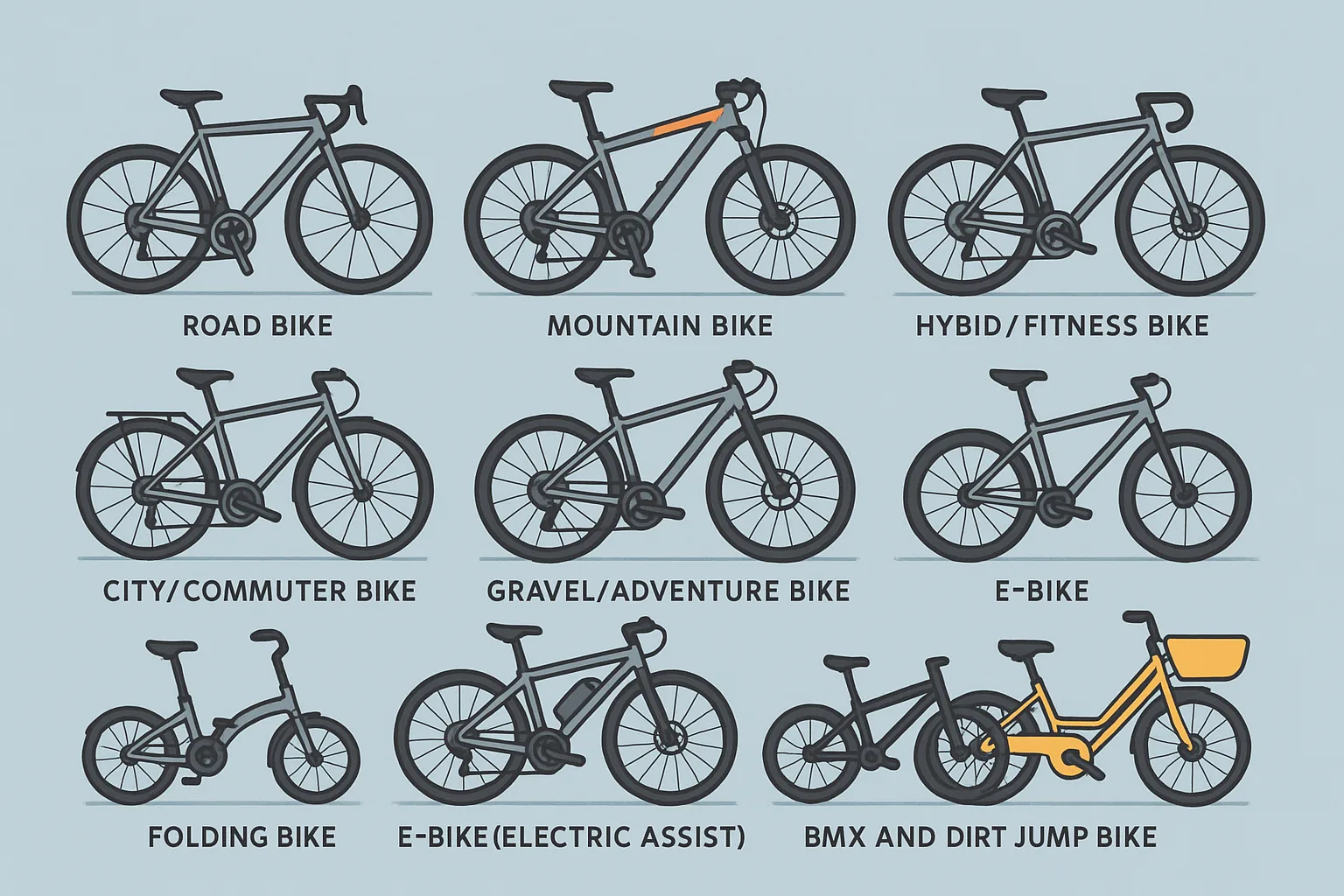
A simple guide to choosing the best bike for your body, your roads, and your goals.
Introduction
Walking into a bike shop can feel confusing. There are road bikes, mountain bikes, hybrids, gravel bikes, folding bikes, and more. They all look different and come with different prices and features. How do you know which one fits you?
The “right” bicycle is not the most expensive or the fastest one. It is the one that fits your body, matches your riding style, and works well on the surfaces you ride most often. In this article, we will:
- Explain the main types of bicycles.
- Show what each type is good and not so good at.
- Help you match a bike type with your goals and environment.
- Give basic tips about bike fit and frame size.
Before You Choose: Key Questions to Ask Yourself
Take a moment to answer these questions. They will guide you to the right category.
- Where will you ride most? Smooth pavement, rough roads, dirt trails, or a mix?
- Why do you want a bike? Commuting, fitness, fun rides, long tours, racing, tricks?
- How far and how often will you ride? Short errands a few times a week or long weekend rides?
- Do you prefer comfort or speed? Upright relaxed posture or more aggressive sport position?
- Do you need to carry things? Groceries, kids, work bag, or nothing at all?
- What is your budget? Entry-level, mid-range, or high-end?
Main Types of Bicycles
Below are the most common bicycle types, with their strengths, weaknesses, and who they fit best.
1. Road Bike
- Lightweight frame and narrow tires designed for speed on pavement.
- Drop handlebars allow multiple hand positions and aerodynamic posture.
- Efficient pedaling and quick acceleration.
Pros: Fast, efficient, great for long distances and group rides.
Cons: Less comfortable on rough roads, limited cargo capacity, more bent-over position.
Fits you if: You want to ride mostly on smooth roads and care about speed or fitness.
2. Mountain Bike (MTB)
- Wide, knobby tires for grip on dirt, rocks, and roots.
- Strong frames and suspension (front “hardtail” or front + rear “full-suspension”).
- Flat handlebars give stable control, especially on steep terrain.
Pros: Very strong, stable, and capable on rough terrain; comfortable upright posture.
Cons: Heavier and slower on pavement; wide tires roll with more resistance.
Fits you if: You plan to ride mostly on trails or rough roads and value control over speed.
3. Hybrid / Fitness Bike
- Mix of road and mountain features: medium-width tires, flat handlebars.
- Comfortable upright position with good visibility in traffic.
- Often has mounts for racks, fenders, and lights.
Pros: Versatile, beginner-friendly, comfortable on most city rides.
Cons: Not as fast as a true road bike or as strong as a full MTB on hard trails.
Fits you if: You want one bike for commuting, fitness, and casual rides on mostly paved or smooth paths.
4. City / Commuter Bike
- Designed for practicality: upright posture, fenders, chain guards, racks.
- Often uses internal gear hubs (3–8 speeds) for low maintenance.
- Comfortable saddle and relaxed geometry.
Pros: Very practical, low-maintenance, good for riding in normal clothes.
Cons: Heavier, not built for high speed or long sport rides.
Fits you if: You ride mostly in the city and value comfort, visibility, and easy maintenance.
5. Gravel / Adventure Bike
- Looks similar to a road bike but with wider tires and more relaxed geometry.
- Handles pavement, gravel, and light trails with confidence.
- Lots of mounts for racks, bottles, and bags.
Pros: Very versatile; great for riders who like to explore beyond smooth roads.
Cons: Slightly heavier than a pure road bike; overkill if you ride only on smooth city streets.
Fits you if: You ride on a mix of pavement and rough roads and enjoy adventure-style rides.
6. Touring Bike
- Strong frame designed to carry heavy loads on racks.
- Comfortable geometry for many hours in the saddle.
- Durable wheels and wide gear range for hills.
Pros: Stable with luggage, comfortable on long trips, very durable.
Cons: Heavier and slower for short, fast rides; more expensive than basic hybrids.
Fits you if: You dream of multi-day bike trips or need to carry lots of gear regularly.
7. Folding Bike
- Hinged frame folds into a compact size to carry onto trains, buses, or into apartments.
- Small wheels but often with gearing that still allows good speed.
- Ideal for people with limited storage or mixed travel (bike + public transport).
Pros: Extremely portable, easy to store indoors, discourages theft.
Cons: Not as stable at high speeds; less comfortable on very rough surfaces.
Fits you if: You live in a small space or combine biking with trains, buses, or car trips.
8. E-Bike (Electric Assist)
- Electric motor assists your pedaling to make hills and headwinds easier.
- Comes in many shapes: city, mountain, folding, and cargo e-bikes.
- Requires charging and is heavier than a non-electric bike.
Pros: Great for longer commutes, carrying loads, or riding even when tired or less fit.
Cons: Higher price, more weight, battery maintenance and charging.
Fits you if: You want to ride more often but worry about distance, hills, or arriving too sweaty.
9. BMX and Dirt Jump Bikes
- Small, strong frames with 20–26" wheels and single gear.
- Built for durability and maneuverability, not for long distances.
Pros: Tough, playful, great for stunts and technical skills.
Cons: Uncomfortable for commuting or long rides.
Fits you if: You mainly want to ride in parks, pump tracks, or do jumps and tricks.
10. Cargo Bike
- Extended frames or front boxes to carry cargo safely.
- Often available with electric assist to move heavy loads.
- Popular car replacement option for urban families.
Pros: Huge carrying capacity, can replace many car trips.
Cons: Bigger, heavier, more expensive, needs more storage space.
Fits you if: You regularly transport children or heavy items and want a bike instead of a car.
How to Choose Based on Your Riding Style
Use this quick guide to connect your main riding style with a recommended bike type.
- Short city commutes & errands: City/commuter bike, hybrid, or e-bike.
- Longer road rides & fitness: Road bike or gravel bike (if roads are rough).
- Off-road trails & mountains: Mountain bike or trail e-MTB.
- Mixed pavement and dirt backroads: Gravel / adventure bike or robust hybrid.
- Apartment living & train commuting: Folding bike or compact e-folding bike.
- Family hauling & car replacement: Cargo bike, possibly electric.
- Traveling across countries: Touring bike or gravel/touring hybrid with racks.
Getting the Right Fit: Frame Size and Comfort
Even the perfect type of bike will feel wrong if the size is off. A good fit means:
- You can stand over the bike with some clearance between your body and the top tube.
- When seated, your leg is slightly bent at the bottom of the pedal stroke (not fully straight, not too bent).
- Your arms and back feel relaxed—no extreme reach to the handlebars.
- You can reach the brakes and shifters comfortably with your fingers.
Small adjustments—like raising or lowering the saddle, moving it forward or backward, or changing the stem—can make a big difference. A professional bike fit is helpful if you plan to ride many hours or have knee, back, or wrist issues.
Other Important Choices
1. Gears
More gears help with hills, but they also mean more components to maintain. For flat cities, 1× (single front chainring) or simple hub gears may be enough. For hilly areas or heavy loads, a wide gear range is helpful.
2. Brakes
- Rim brakes: Lighter and cheaper but less powerful in rain.
- Disc brakes: Stronger and more consistent in all weather; now common on many bikes.
3. Suspension
- No suspension: Lighter and more efficient on smooth roads.
- Front suspension: Good for light trail use and rough urban streets.
- Full suspension: Best for serious off-road riding; heavier and more expensive.
4. Budget and Upgrades
It is usually better to buy a solid, mid-level bike that fits well than a very cheap bike with poor components. A good frame can be upgraded later with better wheels, tires, and parts.
Common Mistakes to Avoid
- Buying a bike that is too small or too big just because it is on sale.
- Choosing a type that does not match your roads, like a narrow-tired road bike for rocky paths.
- Ignoring comfort, thinking you will “get used to it” even if everything hurts.
- Skipping test rides. Riding a bike around the block tells you more than any specification list.
- Not budgeting for accessories, like a helmet, lights, lock, and pump.
Step-by-Step: How to Pick Your Bike
- Define your main riding goal and common route (where, how far, how often).
- Use that goal to choose 1–2 likely bike types (e.g., hybrid vs. city bike).
- Check size charts for your height and inseam to find the correct frame size.
- Visit a shop, ask questions, and test ride several models in your size.
- Pay attention to comfort, control, and how the bike feels under acceleration and braking.
- Choose the bike that feels best within your budget, then adjust saddle and controls for fine fit.
- Add essential accessories: helmet, lock, lights, bell, and basic tools.
Conclusion
The best bicycle for you depends on your roads, your rides, and your body. Road bikes, mountain bikes, hybrids, gravel bikes, folding bikes, and e-bikes all have different strengths. When you match the bike type to your main purpose and choose a size that fits, riding becomes easier, safer, and much more fun.
Start with one simple question: “Where do I really plan to ride this bike most of the time?” Use the information in this guide to narrow down your options, test a few bikes, and choose the one that feels natural under you. The right bike will make you want to ride more—and that is the real goal.