
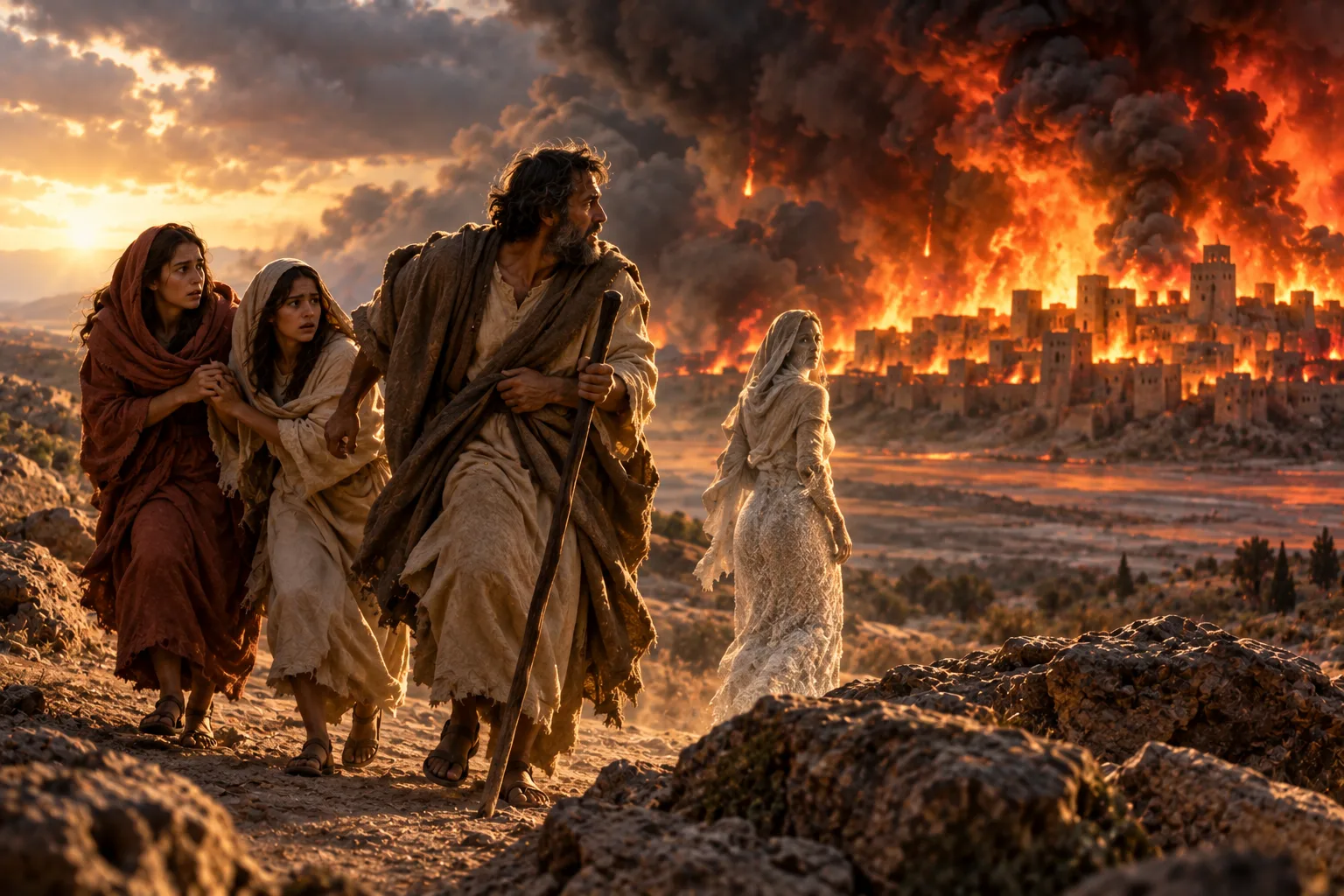
Sodom and Gomorrah are among the most famous cities mentioned in the Bible. Their destruction became such a powerful example of divine judgment that later prophets, apostles, and YESHUA Himself referred to them when warning people about sin, unbelief, injustice, and the consequences of rejecting Elohim.
However, the biblical account of Sodom and Gomorrah is sometimes reduced to only one subject. Scripture presents a broader picture. The cities were characterized by extreme wickedness, sexual immorality, attempted sexual violence, pride, prosperous self-indulgence, neglect of the poor, and a society in which serious evil had become deeply established.
At the same time, the story is not only about judgment. It also reveals Elohim's justice, patience, willingness to hear Abraham's intercession, mercy toward Lot, and desire to rescue people before judgment comes.
Understanding Sodom and Gomorrah therefore requires reading Genesis together with the rest of Scripture. The result is a serious warning, but also a message about mercy, repentance, righteousness, and the importance of taking Elohim's Word seriously.
1. Where Do We First Meet Sodom and Gomorrah?
Sodom and Gomorrah first appear in Genesis during the story of Abraham and Lot. They were cities located in the region of the Jordan plain.
Genesis describes the area as well-watered and attractive before the destruction of the cities. Its fertile appearance made it desirable for livestock and settlement.
When Abraham and Lot needed to separate because their possessions and herds had become too great for them to remain together comfortably, Lot looked toward the fertile Jordan plain and chose that region.
2. Lot Chose What Looked Prosperous
Lot's choice is an important part of the story. From a practical perspective, the land near Sodom looked excellent.
It offered water, pasture, economic opportunity, and apparently prosperous cities.
But Scripture immediately gives the reader information that outward appearances could not reveal:
“But the men of Sodom were exceedingly wicked and sinful against YAHWEH.”
The contrast is important. A place can appear economically attractive while being spiritually dangerous.
Material prosperity alone is therefore not a reliable measure of whether something is good for our lives.
3. Lot Gradually Moved Closer to Sodom
Genesis first describes Lot pitching his tents near Sodom. Later, we find him living within the city itself.
This progression provides an important lesson. Dangerous environments do not always capture people through one dramatic decision. Sometimes compromise develops gradually.
A person may first tolerate something, then become comfortable around it, and eventually become deeply connected to it.
This does not mean believers must completely isolate themselves from sinful societies. Yeshua sent His followers into the world. But believers should recognize that environments influence attitudes, habits, children, relationships, and moral judgment.
4. Sodom Was Already Known for Wickedness
The destruction recorded in Genesis 19 did not occur because of one unexpected incident on a single evening.
Long before the angels arrived at Lot's house, Scripture had already described Sodom's people as extremely wicked.
Genesis 18 later records YAHWEH saying that the outcry against Sodom and Gomorrah was great and their sin was very serious.
The language of an “outcry” is significant because elsewhere in Scripture similar language can describe cries arising from oppression, injustice, or suffering.
Something deeply wrong had become established within these cities.
5. Elohim Investigates Before Judgment
Genesis describes YAHWEH speaking about going down to see whether the cities' actions corresponded to the outcry that had reached Him.
This does not mean Elohim lacked knowledge and needed to collect information as a human investigator would. The narrative emphasizes the careful justice of His judgment.
Elohim is not presented as acting impulsively, emotionally, or without cause.
Judgment comes after serious wickedness has become established.
6. Abraham Intercedes for Sodom
When Abraham learns that judgment is approaching, he does something remarkable: he intercedes.
Abraham asks whether Elohim would destroy righteous people together with the wicked.
“Shall not the Judge of all the earth do right?”
Abraham begins by asking whether the city would be spared if fifty righteous people were found there. The number gradually decreases until Abraham asks about ten.
Each time, Elohim demonstrates willingness to spare the city for the sake of the righteous.
7. Abraham's Conversation Reveals Elohim's Justice and Mercy
Abraham's intercession is not a story about a compassionate Abraham trying to convince a cruel Elohim to become merciful.
Instead, the conversation reveals that Elohim's justice is careful and that He is willing to show extraordinary mercy.
Even ten righteous people would have been enough for the city to be spared.
The tragedy is that the corruption was so extensive that even this small number could not be found.
8. Two Angels Arrive in Sodom
Genesis 19 begins with two angels arriving at Sodom in the evening.
Lot is sitting at the city gate. When he sees the visitors, he invites them into his home and strongly urges them not to remain in the public square overnight.
Lot's concern suggests that he understood how dangerous the city could be.
He offers hospitality and prepares a meal for them.
9. Hospitality Was Important in the Ancient World
Travelers in the ancient Near East were especially vulnerable. Inns, transportation, policing, and communication were nothing like modern systems.
Hospitality therefore provided protection as well as food and shelter.
Lot's willingness to receive strangers contrasts sharply with what happens next.
His household provides hospitality, while the surrounding city responds with hostility and violence.
10. The Men of Sodom Surround Lot's House
Genesis describes men from throughout the city gathering around Lot's house and demanding access to his visitors for sexual purposes.
This is not presented as a loving or consensual relationship. It is an attempted act of collective sexual violence and humiliation against vulnerable strangers.
The incident reveals how deeply violence, lust, domination, and disregard for human dignity had penetrated the city.
The visitors had done nothing to harm the city. They were targeted simply because they were vulnerable outsiders within its walls.
11. The Story Includes Sexual Sin, but It Is Not Only About Sexual Sin
Genesis 19 unquestionably contains sexual wickedness. Later biblical writers also connect Sodom with sexual immorality.
Jude describes Sodom and Gomorrah as examples of sexual immorality and the pursuit of unnatural flesh.
However, reducing Sodom's entire wickedness to only one category misses other biblical testimony.
Scripture also identifies pride, abundance without compassion, neglect of the poor, arrogance, and other abominations.
The biblical picture is therefore one of a deeply corrupted society rather than a city guilty of only one isolated sin.
12. Ezekiel Describes Additional Sins of Sodom
Centuries later, the prophet Ezekiel describes Sodom's wrongdoing:
“She and her daughter had pride, fullness of food, and abundance of idleness; neither did she strengthen the hand of the poor and needy.”
Ezekiel then says they were arrogant and committed abominations before Elohim.
This adds an important dimension to the story. Sodom apparently possessed prosperity, but prosperity did not produce generosity.
People had abundance while vulnerable people were neglected.
13. Prosperity Can Become Spiritually Dangerous
Wealth itself is not evil. Scripture contains righteous people who possessed significant resources.
The danger comes when abundance produces pride, selfishness, indifference, and the illusion that we no longer need Elohim.
Sodom's prosperity did not produce gratitude and generosity. According to Ezekiel, it existed alongside arrogance and neglect of those in need.
This remains an important warning for prosperous individuals and societies today.
14. Neglecting the Poor Matters to Elohim
Some people treat concern for the poor as a minor biblical subject. Scripture does not.
Elohim repeatedly commands His people to care for widows, orphans, foreigners, laborers, and people experiencing poverty.
Ezekiel's description of Sodom demonstrates that a society can become guilty not only through the evil it actively commits, but also through the good it selfishly refuses to do.
Having abundance while becoming completely indifferent to suffering reveals something serious about the heart.
15. Pride Was at the Center of Sodom's Corruption
Ezekiel specifically identifies pride.
Pride says, “I can live however I want. I answer to no one. My desires are more important than another person's dignity.”
This attitude can eventually affect sexuality, money, power, relationships, justice, and treatment of vulnerable people.
Pride is dangerous because it resists correction and repentance.
16. Lot's Response Was Also Deeply Troubling
Lot attempts to protect his guests, but in doing so he offers his daughters to the mob.
Scripture records this disturbing action without requiring readers to approve of it.
The Bible often honestly reports the terrible decisions of human beings. Description is not automatically endorsement.
Lot's proposal shows how morally distorted and desperate the situation had become.
Protecting one person never makes sacrificing another innocent person morally acceptable.
17. The Crowd Rejects Lot's Appeal
Lot asks the men not to act wickedly, but the crowd turns against him.
They accuse him of being an outsider who now wants to judge them.
This reaction reveals another feature of hardened wrongdoing: correction itself becomes offensive.
When a society reaches the point where calling evil “evil” is treated as the greater offense, repentance becomes increasingly difficult.
18. The Angels Rescue Lot
As the crowd threatens Lot, the angels pull him back into the house and strike the attackers with blindness.
Even then, the men continue trying to find the doorway.
Their persistence demonstrates how powerfully sinful desire can control people when restraint has been abandoned.
The angels then tell Lot that the city's destruction is imminent.
19. Lot Warns His Future Sons-in-Law
Lot goes to the men who were expected to marry his daughters and warns them that YAHWEH is about to destroy the city.
They think he is joking.
This is one of the saddest moments in the story. A genuine warning is treated as entertainment.
Judgment seemed impossible until it happened.
20. Lot Himself Hesitates
When morning comes, the angels urgently tell Lot to leave with his wife and daughters.
Surprisingly, Lot hesitates.
He knows judgment is coming, yet something still makes leaving difficult.
This illustrates how deeply people can become attached to familiar places, possessions, routines, and relationships even when remaining there is dangerous.
21. Elohim's Mercy Is Seen in Lot's Rescue
Genesis says that because YAHWEH was merciful to Lot, the angels took him, his wife, and his daughters by the hand and brought them outside the city.
Lot's rescue therefore cannot be described merely as the result of his perfect courage or immediate obedience.
He hesitated, and mercy moved him toward safety.
This is an important theme throughout Scripture: salvation ultimately depends upon Elohim's mercy.
22. “Escape for Your Life”
Once outside the city, Lot and his family receive urgent instructions:
“Escape for your life! Do not look behind you.”
The message is clear. This is not the moment to negotiate with the old life or return for possessions.
Sometimes repentance requires decisive separation from something destructive.
There are situations in which looking for a compromise with evil only increases danger.
23. The Destruction of Sodom and Gomorrah
After Lot reaches safety, Genesis records that YAHWEH rains sulfur and fire upon Sodom and Gomorrah.
The cities, surrounding plain, inhabitants, and vegetation are devastated.
The fertile region that had once attracted Lot becomes a picture of destruction.
What once appeared prosperous and secure disappears suddenly.
24. Lot's Wife Looks Back
Lot's wife disobeys the warning and looks back. Genesis says that she becomes a pillar of salt.
Scripture does not provide a detailed psychological explanation of her motive, so we should be cautious about claiming more than the text reveals.
What is clear is that she had received a direct warning not to look back and did so anyway.
Her story later becomes an explicit warning from YESHUA.
25. YESHUA Said, “Remember Lot's Wife”
When teaching about coming judgment, YESHUA gives one of the shortest warnings recorded in the Gospels:
“Remember Lot's wife.”
The warning concerns divided loyalty. When the moment comes to follow Elohim, attachment to the old life can become spiritually dangerous.
Following YESHUA sometimes requires leaving behind things we once considered essential.
26. Abraham Sees the Aftermath
Abraham rises early and looks toward the region where Sodom and Gomorrah had stood.
He sees smoke rising from the land like smoke from a furnace.
The judgment Abraham had discussed with Elohim was now a visible reality.
Genesis also emphasizes that Elohim remembered Abraham when He rescued Lot from the destruction.
27. Was Lot Righteous?
Genesis presents Lot as a complicated person. He makes questionable choices, lives within a deeply corrupt city, hesitates to leave, and makes disturbing decisions.
Yet 2 Peter describes Lot as righteous and says that he was deeply distressed by the lawless conduct surrounding him.
This does not mean Lot was morally perfect.
Rather, it shows that Scripture can distinguish between an imperfect believer struggling within a corrupt environment and a society that has embraced wickedness without repentance.
28. The Story Does Not End with the Destruction
Genesis continues with an uncomfortable account involving Lot and his daughters after they leave the region.
Their later behavior shows that physically escaping Sodom did not automatically remove every distorted idea or consequence associated with their former environment.
Leaving a destructive environment can be an important beginning, but healing, renewed thinking, repentance, and spiritual growth may still be necessary afterward.
29. Sodom Became a Symbol Throughout Scripture
After Genesis, Sodom and Gomorrah repeatedly appear as symbols of extreme corruption and divine judgment.
Moses refers to them. Isaiah uses Sodom as a comparison when confronting rebellion. Jeremiah refers to their wickedness. Ezekiel discusses their pride and neglect of the poor. Amos remembers their destruction. YESHUA uses them as warnings, and the apostles Peter and Jude present them as examples of judgment.
This means their story was never intended to remain only an ancient historical account. Scripture uses it to instruct later generations.
30. Isaiah Shows That “Sodom” Can Describe Religious Hypocrisy
Isaiah addresses rebellious people using language associated with Sodom and Gomorrah while confronting outward religious activity that existed alongside injustice.
They offered sacrifices and observed religious practices, but Elohim demanded repentance, justice, protection of the oppressed, and care for vulnerable people.
This teaches an important lesson: religious activity cannot compensate for a life characterized by injustice and rebellion.
31. Jeremiah Connects Sodom with Adultery, Lies, and Unrepentant Evil
Jeremiah compares corrupt prophets to Sodom because of adultery, deception, and strengthening people who practice evil rather than calling them to repentance.
This adds another dimension to the biblical portrait.
Spiritual leaders become part of societal corruption when they encourage people to remain comfortable in wrongdoing instead of speaking truth.
32. Jude Connects Sodom with Sexual Immorality
Jude specifically remembers Sodom, Gomorrah, and surrounding cities in connection with sexual immorality and the pursuit of unnatural flesh.
Therefore, it would also be incorrect to remove sexual sin from the story completely.
A balanced reading allows all the biblical witnesses to speak: sexual immorality, violent lust, pride, injustice, arrogance, lack of hospitality, neglect of the poor, and broader rebellion all belong within Scripture's portrait of Sodom.
33. YESHUA Used Sodom as a Warning About Rejecting the Truth
YESHUA sent His disciples to proclaim the Kingdom. He warned that communities rejecting their message would face serious accountability.
He said that it would be more tolerable for Sodom and Gomorrah in the day of judgment than for certain places that rejected greater revelation.
This teaches an important principle: greater knowledge brings greater responsibility.
Sodom's judgment was terrible, but deliberately rejecting the truth after receiving greater light is also extremely serious.
34. YESHUA Compared the Last Days with Lot's Time
In Luke 17, YESHUA compares the days before future judgment with the days of Lot.
People were eating, drinking, buying, selling, planting, and building. These activities are not sinful by themselves.
The point is that ordinary life continued as though judgment would never come.
Then destruction arrived suddenly.
YESHUA's warning is against spiritual complacency.
35. Judgment Can Come While Life Appears Normal
One of the most sobering lessons of Sodom is that normal activity can continue right up until a major change occurs.
People can work, trade, eat, build homes, make plans, and assume tomorrow will resemble today.
Scripture therefore teaches us not to confuse ordinary circumstances with spiritual security.
Life is uncertain, and every person should remain prepared before Elohim.
36. Elohim's Patience Should Lead to Repentance
Judgment did not fall upon Sodom the first moment anyone sinned.
The biblical narrative shows wickedness becoming severe and the outcry becoming great.
Elohim's patience should never be interpreted as approval.
When consequences do not arrive immediately, people may assume their behavior does not matter. Scripture teaches the opposite. Patience provides opportunity for repentance.
37. Elohim's Judgment Is Not Arbitrary
The conversation with Abraham emphasizes the righteousness of the Judge of all the earth.
Elohim knows what human courts cannot know. He sees motives, actions, victims, hidden wrongdoing, and every circumstance completely.
Human beings frequently judge with incomplete evidence. Elohim does not.
His judgment is based upon perfect knowledge.
38. Mercy and Judgment Are Both Present
Some people want to speak only about Elohim's mercy. Others emphasize only judgment.
The story of Sodom and Gomorrah contains both.
Elohim listens to Abraham, would spare the city for a small righteous remnant, warns Lot, physically leads his hesitant family toward safety, and permits their escape.
But persistent wickedness is eventually judged.
Biblical mercy does not mean that evil will remain unanswered forever.
39. Do Not Celebrate the Destruction of Sinners
The story should not make believers eager to see other people destroyed.
Abraham's response was intercession, not celebration.
This is important for followers of YESHUA. When we see people living destructively, our response should include prayer, truth, compassion, and hope for repentance.
Warning people about judgment should never become an excuse for hatred.
40. Sodom Should Not Be Used as a Weapon for Self-Righteousness
It is easy to read the story and identify the sins of other people while ignoring our own.
But Scripture's later references to Sodom include pride, greed, sexual immorality, injustice, neglect of the poor, arrogance, and resistance to truth.
These warnings should cause every reader to examine their own heart.
The proper response is not, “Those people are terrible.” It is also, “Elohim, show me where I need to repent.”
41. Sexual Purity Still Matters
Modern readers should not erase the sexual dimension of the account simply because it can be controversial.
Scripture consistently teaches that sexuality has moral boundaries established by Elohim.
At the same time, biblical sexual ethics should never be used to justify hatred, humiliation, violence, or mistreatment of people.
Followers of YESHUA are called to combine truth with love, personal holiness with humility, and conviction with compassion.
42. Consent Does Not Describe What Happened at Lot's House
The attempted assault in Genesis 19 should be understood for what the narrative actually depicts: a mob attempting to sexually violate vulnerable visitors.
Violence and sexual domination are serious violations of another person's dignity.
No interpretation of the story should minimize this element.
43. How Should We Think About Modern Societies?
People sometimes quickly label a modern city or nation “Sodom.”
We should be cautious about claiming to know that Elohim will judge a particular modern city in exactly the same manner.
What we can do is apply the moral warnings Scripture itself emphasizes.
A society should be concerned when pride is celebrated, vulnerable people are exploited, sexual violence becomes tolerated, wealth produces indifference, truth is rejected, injustice spreads, and repentance is mocked.
44. Families Should Consider the Environment Around Them
Lot's experience reminds parents and families that environment matters.
Housing, employment, income, and convenience are important considerations when deciding where to live, but they should not be the only considerations.
Parents should also think about safety, influences, community, relationships, education, spiritual life, and the environment in which children are developing.
The most financially attractive option is not automatically the best overall choice.
45. Do Not Become Comfortable with What Once Troubled You
Repeated exposure can change our sensitivity.
Things that once shocked us may gradually begin to seem normal simply because we encounter them repeatedly.
Believers should regularly return to Scripture so that their moral understanding is shaped by Elohim's truth rather than merely by whatever becomes culturally common.
46. Repentance Means More Than Feeling Sorry
The command to flee Sodom illustrates an important principle about repentance.
Repentance involves turning.
If a person recognizes that something is destroying their life but continually returns to it without seeking change, recognition alone is not enough.
Depending on the situation, repentance may require ending a sinful relationship, changing habits, seeking accountability, returning stolen property, confessing dishonesty, leaving a dangerous environment, or asking for help.
47. Do Not Look Back Longingly at the Life Elohim Is Calling You to Leave
Lot's wife remains a powerful warning because physical escape is not the same as wholehearted separation.
A person can leave something physically while continuing to desire it internally.
YESHUA's words, “Remember Lot's wife,” remind believers to examine where their treasure and loyalty truly remain.
48. The Story Points Beyond Sodom to Final Judgment
Peter and Jude use Sodom and Gomorrah as examples showing that Elohim takes persistent rebellion seriously.
YESHUA also uses Sodom when teaching about the day of judgment.
The ancient destruction therefore points beyond itself. Scripture teaches that every human being will ultimately answer to Elohim.
Earthly consequences are not the final measure of justice.
49. The Gospel Offers an Escape Greater Than Lot's
Lot needed rescue from a city facing physical destruction. The Gospel addresses an even deeper problem: humanity's slavery to sin and separation from Elohim.
YESHUA came not merely to warn people about judgment but to save.
Through His death and resurrection, forgiveness and reconciliation with Elohim are offered to sinners who repent and trust Him.
This means the message of judgment is accompanied by an invitation to mercy.
50. No One Is Saved by Being Better Than Sodom
The Gospel does not divide humanity into “terrible sinners like Sodom” and “good people who need no mercy.”
All people have sinned and need the grace of Elohim.
Some sins may produce different earthly consequences, but no person earns eternal life by comparing themselves favorably with someone worse.
Salvation comes through Yeshua, not through self-righteous comparison.
51. Major Lessons from Sodom and Gomorrah
- Elohim sees both public and hidden wickedness.
- Elohim's patience should not be mistaken for approval.
- Persistent sin has consequences.
- Sexual violence and immorality are serious before Elohim.
- Pride can corrupt individuals and societies.
- Prosperity without compassion can harden the heart.
- Neglecting the poor matters to Elohim.
- Material attractiveness does not guarantee spiritual safety.
- Environment can influence individuals and families.
- Believers should intercede for sinners rather than hate them.
- Elohim distinguishes the righteous from the wicked.
- Mercy can precede judgment.
- Warnings from Elohim should be taken seriously.
- Repentance sometimes requires decisive action.
- We should not look back longingly toward what Elohim calls us to leave.
- Greater revelation brings greater responsibility.
- Everyone needs the mercy offered through YESHUA.
52. Questions for Personal Reflection
- Have I allowed something sinful to become normal simply because it is common around me?
- Has prosperity made me less dependent upon Elohim?
- Do I care about people who are poor, vulnerable, or outsiders?
- Am I willing to receive correction?
- Is pride preventing me from admitting that something in my life needs to change?
- Am I remaining in a spiritually destructive environment only because it is comfortable or profitable?
- When I see others living in sin, do I respond with hatred or with truth, prayer, and hope for repentance?
- Is there something Elohim is calling me to leave behind?
- Am I following YESHUA wholeheartedly, or continually looking back?
53. A Prayer for Mercy and Repentance
YAHWEH Elohim, You are righteous, merciful, and just. Search my heart and show me where pride, selfishness, sexual sin, greed, injustice, or indifference may be growing in my life. Help me never become comfortable with what You call evil. Give me compassion for people who are suffering and courage to help those in need. Teach me to receive correction with humility and to repent when I am wrong. Thank You for the mercy and salvation You have provided through YESHUA. Help me follow Him without turning back. Amen.
Conclusion
Sodom and Gomorrah stand in Scripture as a serious warning about what can happen when wickedness becomes deeply rooted and repentance is rejected.
Their story involves sexual immorality and attempted sexual violence, but Scripture does not stop there. The prophets also identify pride, arrogance, prosperity without compassion, neglect of the poor, deception, and broader rebellion against Elohim.
At the same time, Genesis reveals remarkable mercy. Elohim listens to Abraham's intercession, distinguishes Lot from the surrounding wickedness, warns his family, and even takes the hesitant Lot by the hand to lead him toward safety.
The lesson is therefore neither “Elohim never judges” nor “Elohim only wants to destroy sinners.” Scripture reveals both justice and mercy. Evil matters, but Elohim also provides an opportunity to turn away from it.
YESHUA Himself tells us to remember the days of Lot and to remember Lot's wife. His warning calls us to remain spiritually awake, refuse divided loyalty, and recognize that ordinary life will not continue forever.
Most importantly, the Gospel shows that Elohim has provided a greater rescue through YESHUA the MESSIAH. Every person needs mercy. Instead of using Sodom's story to condemn others from a position of pride, we should allow it to examine our own hearts, lead us toward repentance, increase our compassion for others, and strengthen our determination to follow YESHUA faithfully.