
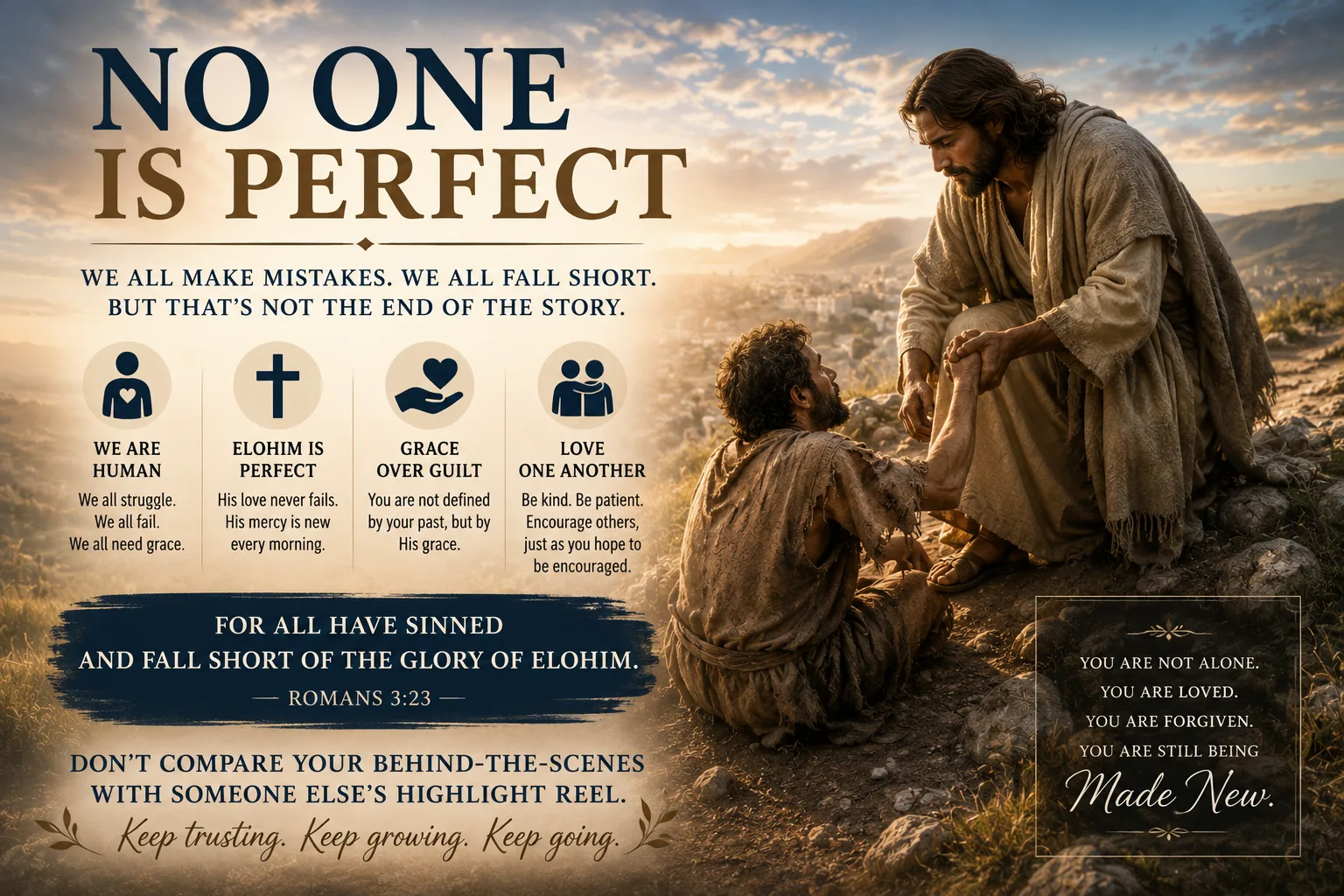
No human being is perfect. Every person has weaknesses, makes mistakes, struggles with wrong desires, and sometimes hurts others. The Bible teaches that all people have sinned and fall short of Elohim’s perfect standard.
This truth should not lead us into hopelessness. Instead, it should lead us toward humility, repentance, mercy, and faith in YESHUA the MESSIAH. The Gospel does not teach that people must become perfect before coming to Elohim. It teaches that Elohim receives sinners who turn to Him, forgives them through YESHUA, and patiently transforms their lives.
Saying “no one is perfect” should never become an excuse for continuing in sin without repentance. It should remind us that everyone needs grace, correction, patience, and the power of Elohim to grow.
1. What Does It Mean to Say No One Is Perfect?
To say that no one is perfect means that every human being has limitations and moral weaknesses. People can misunderstand situations, make poor decisions, speak carelessly, act selfishly, or fail to do what is right.
Some imperfections are ordinary human limitations. A person may forget something, lack knowledge, misunderstand instructions, or perform a task poorly. Other imperfections involve sin, such as lying, pride, hatred, greed, lust, cruelty, or dishonesty.
The Bible does not treat every mistake as equally serious, but it clearly teaches that no one is completely without sin.
2. All People Have Sinned
Scripture teaches that sin is a universal human problem. It affects every nation, family, culture, and generation. No one can honestly claim to have always loved Elohim perfectly or always treated others rightly.
“For all have sinned and fall short of the glory of Elohim.”
Sin is more than making an accidental mistake. It includes rebellion against Elohim, disobedience to His instructions, selfish motives, and failure to love Him and others as we should.
This truth places every person on equal ground. The rich and poor, educated and uneducated, religious and nonreligious all need mercy.
3. Elohim Alone Is Perfect
Human beings are imperfect, but Elohim is completely holy, righteous, faithful, wise, and good. He never lies, acts unjustly, makes a mistake, or fails to keep His promises.
Elohim’s perfection is the standard by which truth, righteousness, and goodness are understood. Human opinions change, but His character remains constant.
Recognizing Elohim’s perfection should produce worship and humility. We do not compare ourselves only with other people. We examine our lives in the light of His holiness.
4. YESHUA Is the Perfect Example
The Bible presents YESHUA the MESSIAH as without sin. He was tempted, misunderstood, rejected, and mistreated, yet He remained faithful to Elohim.
YESHUA loved people, spoke truth, resisted temptation, forgave sinners, confronted hypocrisy, and obeyed the Father completely.
His perfect life reveals both the standard of righteousness and humanity’s need for salvation. We do not save ourselves by copying YESHUA perfectly. We first receive grace through Him, and then we learn to follow His example.
5. Imperfection Is Not an Excuse for Sin
People sometimes say, “Nobody is perfect,” to avoid responsibility. They may use the phrase to excuse repeated lying, unfaithfulness, anger, addiction, abuse, or dishonesty.
The Bible teaches mercy, but it also teaches repentance. Repentance means admitting sin, turning away from it, seeking forgiveness, and making real changes.
A person who says, “No one is perfect,” while refusing correction is not practicing humility. True humility admits weakness and seeks help from Elohim.
6. The Difference Between Weakness and Rebellion
There is a difference between struggling against sin and choosing to live comfortably in it. A believer may fall, feel sorrow, repent, and continue fighting. Another person may deliberately defend sin and reject every warning.
Elohim is patient with weakness, but Scripture warns against hardened rebellion. Grace comforts the repentant, but it should not be used to justify ongoing disobedience.
The important question is not whether a person has ever failed. The question is how they respond when truth exposes their failure.
7. Imperfect People Can Still Be Used by Elohim
The Bible contains many examples of imperfect people whom Elohim used for important purposes. Some were fearful, impulsive, proud, dishonest, angry, or spiritually weak.
Their failures were not hidden, but neither were their lives defined only by those failures. Elohim corrected, restored, taught, and used them.
This gives hope to ordinary people. Elohim does not require a flawless past before He begins working in a person’s life. He looks for faith, repentance, obedience, and willingness to grow.
8. Grace Is for Imperfect People
Grace is Elohim’s undeserved kindness toward sinners. It cannot be earned by perfect behavior, religious activity, or personal achievement.
Through YESHUA, Elohim offers forgiveness, reconciliation, and eternal life. This does not mean sin is unimportant. The cross shows that sin is serious, but it also reveals the greatness of Elohim’s mercy.
Grace does not tell us to remain as we are. Grace receives us and begins changing us.
9. Forgiveness Does Not Mean Perfection
When a person is forgiven through YESHUA, they do not immediately become incapable of failure. They begin a new life of growth, correction, obedience, and spiritual transformation.
Believers still need prayer, Scripture, fellowship, self-control, and repentance. They may still struggle with old habits and weaknesses.
Forgiveness changes a person’s relationship with Elohim, while spiritual growth gradually changes their character and conduct.
10. Spiritual Growth Is a Process
Spiritual maturity usually develops over time. Just as a child grows gradually, a believer grows through repeated choices, correction, experience, discipline, and dependence on the Holy Spirit.
Growth may involve progress and setbacks. A person may overcome one weakness while discovering another. This should not produce despair. It should produce deeper dependence on Elohim.
The goal is not to pretend to be perfect. The goal is to continue becoming more faithful, loving, truthful, humble, and obedient.
11. How to Respond When You Fail
Failure can produce shame, fear, denial, or discouragement. The Bible teaches a better response.
When you fail:
- Admit the truth without making excuses.
- Confess your sin to Elohim.
- Ask forgiveness from anyone you harmed.
- Accept appropriate consequences.
- Identify what contributed to the failure.
- Remove opportunities for repeated sin.
- Seek wise help and accountability.
- Receive Elohim’s mercy and begin again.
Failure should become a place of repentance and learning rather than a permanent identity.
12. Do Not Let Shame Define You
Shame says, “You failed, so you are worthless.” The Gospel says, “You sinned, but forgiveness and restoration are available through YESHUA.”
Healthy conviction identifies wrongdoing and leads a person back to Elohim. Destructive shame pushes a person toward secrecy, hopelessness, and isolation.
A believer should take sin seriously without believing that failure places them beyond Elohim’s mercy.
13. Do Not Compare Your Weaknesses with Another Person’s Strengths
Comparison can create pride or discouragement. We may feel superior when we notice another person’s failure, or worthless when we compare ourselves with someone who appears more successful.
Every person has different strengths, weaknesses, experiences, responsibilities, and stages of growth. What appears perfect from the outside may hide private struggles.
Instead of comparing, we should examine our own lives honestly and encourage others in their growth.
14. Be Patient with Other People’s Imperfections
Remembering our own weaknesses should make us more patient with others. Family members, friends, coworkers, and fellow believers will sometimes disappoint us.
Patience does not mean approving harmful behavior. It means allowing room for learning, correction, repentance, and growth.
We should avoid demanding from others a perfection that we cannot produce ourselves.
15. Correct Others with Humility
Sometimes correction is necessary. Love does not ignore sin that is harming a person or others. However, correction should be offered with humility.
Before correcting someone, examine your motive. Are you trying to restore the person, or are you trying to embarrass them and prove yourself superior?
Gentle correction recognizes that the person giving advice is also imperfect and dependent on grace.
16. Forgive Imperfect People
Because no one is perfect, every close relationship needs forgiveness. Marriage, family, friendship, and community cannot remain healthy when people keep permanent records of every mistake.
Forgiveness releases personal revenge and makes healing possible. It does not always restore trust immediately, and it does not remove the need for accountability.
Trust may need to be rebuilt through honesty, repentance, changed behavior, and time.
17. Imperfection Does Not Require Tolerating Abuse
The truth that no one is perfect must never be used to excuse violence, sexual abuse, manipulation, cruelty, or repeated dangerous behavior.
A person may forgive while still leaving an unsafe situation, reporting wrongdoing, seeking legal protection, or establishing strong boundaries.
Ordinary human mistakes and serious patterns of abuse are not the same. Wisdom, safety, justice, and accountability are necessary.
18. Perfectionism Can Become Harmful
Perfectionism is the belief that mistakes are unacceptable and that personal worth depends on flawless performance. It can create anxiety, fear, pride, procrastination, and exhaustion.
A perfectionist may avoid trying new things because of fear of failure. They may also become harsh toward themselves and others.
Biblical excellence is different from perfectionism. Excellence means doing our best faithfully. Perfectionism demands that we never make mistakes.
19. Healthy Excellence Versus Perfectionism
Healthy excellence:
- Works diligently and responsibly.
- Accepts correction and learns from mistakes.
- Recognizes human limitations.
- Allows rest and recovery.
- Finds identity in Elohim rather than performance.
Unhealthy perfectionism:
- Believes every mistake is a disaster.
- Hides weaknesses to protect an image.
- Constantly fears criticism.
- Judges others harshly.
- Connects personal worth with achievement.
20. You Can Be Honest About Your Weaknesses
Pretending to be perfect creates isolation. Honest people can admit that they need help, prayer, wisdom, and correction.
Appropriate honesty builds trust and encourages others who are struggling. It reminds the community of faith that everyone depends on Elohim’s grace.
Honesty should be wise. Not every private struggle should be shared publicly, but trusted and mature people can provide helpful accountability and support.
21. Learn from Mistakes
Mistakes can become valuable teachers when we respond with humility. A failure may reveal weak boundaries, poor planning, hidden pride, lack of knowledge, or unhealthy influences.
Instead of asking only, “Why did this happen to me?” it may be helpful to ask, “What can I learn, and what should I change?”
Wisdom does not simply regret the past. It uses the past to make better choices in the future.
22. Do Not Expect a Perfect Family
Every family has weaknesses. Parents make mistakes, spouses misunderstand one another, children disobey, and relatives sometimes cause conflict.
A healthy family is not one without problems. It is one in which members can communicate honestly, admit wrongdoing, forgive, establish boundaries, and continue growing.
Families become stronger when they stop protecting a false image of perfection and begin practicing truth, mercy, responsibility, and repentance.
23. Do Not Expect a Perfect Church
A congregation is made up of imperfect people. There may be misunderstandings, disagreements, immaturity, and failure.
This does not mean serious wrongdoing should be ignored. Churches must address false teaching, abuse, corruption, and harmful behavior responsibly.
However, believers should not abandon every community simply because someone makes an ordinary mistake. Spiritual fellowship requires patience, correction, forgiveness, and commitment to truth.
24. Do Not Expect a Perfect Life Partner
No husband or wife will meet every expectation perfectly. Every marriage joins two imperfect people with different backgrounds, personalities, habits, and weaknesses.
A wise person looks for faith, character, honesty, responsibility, and willingness to grow rather than expecting flawlessness.
Marriage requires communication, patience, forgiveness, sacrifice, and mutual correction. Serious warning signs should not be ignored, but ordinary imperfections should be handled with grace and wisdom.
25. Do Not Expect Perfect Children
Children are learning. They will make mistakes, test boundaries, forget instructions, and need repeated correction.
Parents should guide them patiently without expecting adult maturity from a child. Discipline should teach responsibility rather than create fear and shame.
Children also need to see adults admit mistakes. A parent who apologizes teaches humility more effectively than a parent who pretends never to be wrong.
26. Do Not Expect Perfect Parents
Parents are also imperfect. They may make poor decisions, speak carelessly, fail to understand their children, or repeat patterns learned from their own families.
Adult children may need to forgive their parents while also recognizing real harm and establishing healthy boundaries.
Honoring parents does not mean pretending they never did anything wrong. It means responding with truth, dignity, wisdom, and freedom from personal revenge.
27. Practical Ways to Grow Despite Imperfection
- Pray honestly about your weaknesses.
- Read Scripture consistently.
- Accept correction without immediate defensiveness.
- Confess sin and make necessary changes.
- Develop healthy routines and boundaries.
- Seek wise and trustworthy accountability.
- Apologize when you harm someone.
- Learn from mistakes instead of hiding them.
- Be patient with gradual growth.
- Depend on the Holy Spirit rather than personal strength alone.
28. How to Treat Imperfect People
- Listen before forming conclusions.
- Correct with gentleness and truth.
- Forgive ordinary offenses.
- Set boundaries around harmful behavior.
- Avoid gossip and public humiliation.
- Encourage progress rather than demanding instant change.
- Remember your own need for mercy.
- Pray for the person’s restoration.
- Protect victims when serious harm occurs.
- Leave final judgment to Elohim.
29. The Hope of the Gospel
The Gospel is good news for imperfect people. YESHUA did not come only for those who appeared righteous. He came to call sinners to repentance and bring them back to Elohim.
Through His death and resurrection, forgiveness and new life are offered. Believers are not accepted because they have reached perfection, but because they trust in YESHUA and receive Elohim’s grace.
This grace creates hope. Your past does not have to control your future. Your weakness does not have to become your permanent identity. Elohim can restore, teach, strengthen, and transform.
30. One Day Elohim Will Complete His Work
In this life, believers continue growing and struggling. Complete freedom from every weakness will not be experienced until Elohim completes His work.
This future hope encourages patience. We should take growth seriously without expecting ourselves or others to reach complete perfection immediately.
Elohim is faithful. What He begins in those who trust Him, He is able to continue and complete.
Conclusion
No one is perfect. Every human being has sinned, made mistakes, and fallen short of Elohim’s standard. This truth should destroy pride, but it should not destroy hope.
Through YESHUA the MESSIAH, forgiveness, restoration, and new life are available. Grace does not excuse sin; it gives us the opportunity and strength to repent and grow.
Because we are imperfect, we need humility, patience, correction, forgiveness, accountability, and healthy boundaries. We should not pretend to be flawless, nor should we use imperfection as an excuse to continue harming others.
The faithful life is not a life without failure. It is a life that repeatedly returns to Elohim, receives His mercy, learns from correction, and continues becoming more like YESHUA.