
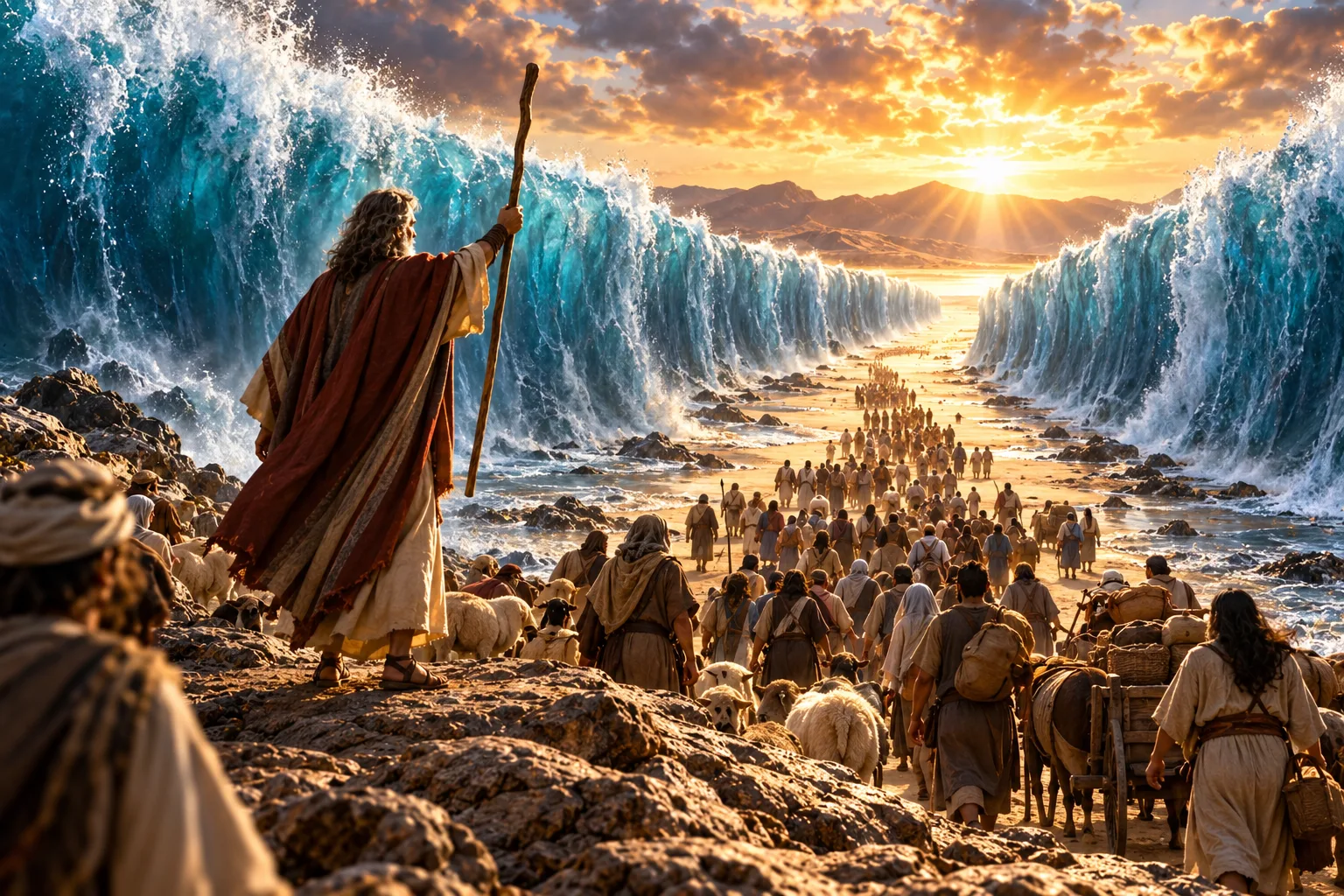
The journey of the Israelites from Egypt to the land of Canaan is one of the most important and remarkable stories in the Bible. It is a story of slavery and freedom, suffering and deliverance, faith and doubt, obedience and rebellion, judgment and mercy, and the faithfulness of YAHWEH Elohim to His promises.
What began with a promise to Abraham eventually became the journey of an entire nation. Under the leadership of Moses, the Israelites escaped slavery in Egypt, crossed the Red Sea, received Elohim's commandments at Mount Sinai, traveled through the wilderness, and eventually reached the land promised to their ancestors.
However, the journey was far from easy. Although the Israelites were delivered from Egypt through extraordinary miracles, they repeatedly struggled with fear, impatience, disobedience, and unbelief. A journey that could have been much shorter became a forty-year wilderness experience.
Through these events, Scripture teaches that receiving freedom is only the beginning. Learning to trust Elohim, obey His instructions, live as His people, and remain faithful through difficulties is an essential part of the journey.
This article explores the Israelites' journey chronologically, from the promises made to Abraham to the conquest and settlement of Canaan under Joshua, while examining the spiritual lessons for believers today.
1. The Promise to Abraham: Where the Journey Began
The journey to Canaan began long before Moses was born. Its foundation was established when YAHWEH called Abraham, originally known as Abram, to leave his homeland and travel to a land that Elohim would show him.
In Genesis 12:1–3, YAHWEH promised Abraham that He would make him into a great nation, bless him, make his name great, and bring blessing to all the families of the earth through him.
Elohim also promised the land of Canaan to Abraham's descendants (Genesis 12:7; 15:18–21).
At that time, Abraham did not possess the entire land. He lived as a foreigner and trusted the promise of Elohim even though its complete fulfillment would occur in future generations.
The journey to Canaan therefore began with faith in a promise rather than possession of the land.
2. The Covenant Continues Through Isaac and Jacob
YAHWEH reaffirmed His covenant with Abraham's son Isaac and later with Isaac's son Jacob.
Jacob, whose name was changed to Israel, became the father of twelve sons whose descendants formed the twelve tribes of Israel.
These tribes would eventually become the nation that Elohim delivered from Egypt.
The covenant was not forgotten when Abraham died. It continued through the generations according to the faithfulness of Elohim.
3. Joseph and the Israelites' Arrival in Egypt
One of Jacob's sons, Joseph, was sold into slavery by his brothers and taken to Egypt.
Through a series of difficult experiences, including false accusation and imprisonment, Joseph eventually became a powerful administrator under Pharaoh.
When a severe famine affected Canaan and surrounding regions, Joseph was able to provide food for his family.
Jacob and his household moved to Egypt, where they settled in the region of Goshen.
What appeared to be a temporary solution to famine eventually became a long period of residence in a foreign land.
4. From Guests to Slaves
Over time, Joseph and his generation died. A new Pharaoh arose who did not recognize Joseph's contributions.
The Israelites had multiplied greatly, and Egypt's rulers began to fear their growing population.
Pharaoh subjected them to forced labor, using them to build storage cities and perform exhausting work.
Their lives became bitter under harsh treatment.
Pharaoh also ordered the killing of Hebrew male infants, revealing the cruelty of the oppression.
Yet despite their suffering, the Israelites continued to multiply.
5. Elohim Heard the Cries of His People
Exodus describes the Israelites crying out because of their slavery.
Their suffering was not ignored.
Exodus 2:24–25 explains that Elohim heard their groaning, remembered His covenant with Abraham, Isaac, and Jacob, and took notice of His people.
The word "remembered" does not mean Elohim had forgotten. It emphasizes His faithfulness in acting according to His covenant.
Even after generations of hardship, His promise remained.
6. The Birth and Preservation of Moses
Moses was born during the time when Pharaoh ordered Hebrew baby boys to be killed.
His mother hid him for three months before placing him in a waterproof basket among the reeds of the Nile.
Pharaoh's daughter discovered the child and took him into her household.
Moses was raised in Egypt's royal environment, yet he belonged to the people of Israel.
His unusual upbringing would later become part of his preparation for leadership.
7. Moses Flees to Midian
As an adult, Moses saw an Egyptian beating a Hebrew and killed the Egyptian.
When his action became known, he fled Egypt and settled in Midian.
There he married Zipporah, became part of Jethro's household, and worked as a shepherd.
Moses moved from royal surroundings to a much simpler life.
His years in Midian were an important transition before he received his calling from YAHWEH.
8. YAHWEH Appears in the Burning Bush
While tending sheep near Horeb, the mountain of Elohim, Moses saw a bush burning without being consumed.
YAHWEH called to him from the bush and commanded him to remove his sandals because he was standing on holy ground.
Elohim revealed that He had seen the suffering of the Israelites and would deliver them from Egypt.
Moses was appointed to confront Pharaoh and lead the people out.
When Moses asked about Elohim's name, YAHWEH revealed Himself in connection with the declaration "I AM WHO I AM" (Exodus 3:14–15).
The deliverance would reveal YAHWEH's identity, faithfulness, and power.
9. Moses Doubts His Ability
Moses did not immediately accept the assignment with confidence.
He questioned whether the Israelites would believe him and expressed concern about his ability to speak.
YAHWEH provided signs and appointed Aaron, Moses' brother, to help communicate with Pharaoh.
This shows that Elohim's purposes do not depend entirely on human confidence or natural ability.
Moses had weaknesses, but Elohim equipped him for the task.
10. Moses Confronts Pharaoh
Moses and Aaron went before Pharaoh with the command to release the Israelites so they could worship YAHWEH.
Pharaoh refused.
Instead of reducing the Israelites' suffering, he increased their workload.
The people became discouraged and blamed Moses and Aaron for making their situation worse.
Deliverance did not immediately produce easier circumstances.
11. The Ten Plagues of Egypt
YAHWEH sent a series of judgments upon Egypt to demonstrate His authority and confront Pharaoh's refusal.
The ten plagues recorded in Exodus 7–12 were:
- Water turned into blood.
- Frogs covered the land.
- Gnats or lice afflicted people and animals.
- Swarms of flies brought devastation.
- Disease struck Egyptian livestock.
- Boils afflicted people and animals.
- Severe hail destroyed crops and property.
- Locusts consumed remaining vegetation.
- Darkness covered Egypt for three days.
- The firstborn of Egypt died.
These events demonstrated that Pharaoh's political authority was not greater than the power of YAHWEH.
Pharaoh repeatedly resisted, and the confrontation intensified.
12. The First Passover
Before the final plague, YAHWEH instructed Israelite households to sacrifice a lamb and place its blood upon their doorframes.
They were to eat the meal with unleavened bread and bitter herbs, prepared to depart.
The blood served as the appointed sign by which their households would be spared from the judgment.
This event became the foundation of Passover, a continuing remembrance of deliverance from Egypt.
In the New Testament, Paul connects the Passover theme with YESHUA the MESSIAH, describing Him as our Passover sacrifice (1 Corinthians 5:7).
13. The Israelites Finally Leave Egypt
Following the death of the Egyptian firstborn, Pharaoh permitted the Israelites to leave.
Exodus describes the people departing with their families, livestock, and possessions.
The Bible speaks of approximately six hundred thousand men traveling on foot, besides women and children, along with a mixed multitude.
Scholars debate how the ancient population figures should be understood, but the biblical narrative emphasizes that an entire people was delivered.
Their departure marked the beginning of a new national identity.
14. Elohim Leads Them with Cloud and Fire
YAHWEH guided the Israelites with a pillar of cloud during the day and a pillar of fire at night.
These visible signs represented His presence and guidance.
The Israelites did not have modern maps, roads, navigation systems, or established supply routes for such a large traveling community.
They were learning to depend upon Elohim as their guide.
15. Why Did Elohim Not Lead Them by the Shortest Route?
Exodus 13 explains that Elohim did not lead the Israelites by the shorter road through Philistine territory.
He knew that encountering war too early might cause them to lose courage and return to Egypt.
Instead, He led them by a wilderness route toward the sea.
This teaches that the shortest route is not always the wisest route.
Elohim understood the people's weaknesses and led them according to His purposes.
16. Pharaoh Changes His Mind
After releasing the Israelites, Pharaoh and his officials regretted losing their labor force.
Pharaoh gathered his chariots and soldiers and pursued them.
The Israelites found themselves trapped between the advancing Egyptian army and the sea.
Fear spread through the camp.
Many accused Moses of bringing them into the wilderness to die.
17. The Crossing of the Red Sea
Moses told the people to stand firm and witness YAHWEH's deliverance.
Elohim instructed Moses to stretch out his hand over the sea.
A strong wind drove the waters apart, allowing the Israelites to cross on dry ground.
The Egyptian forces pursued them, but the waters returned and overwhelmed the pursuing army.
The crossing became one of Israel's defining memories of deliverance.
The people had escaped an enemy they could not defeat by their own strength.
18. The Song of Moses and Miriam
After crossing the sea, Moses and the Israelites sang a song praising YAHWEH for His victory.
Miriam also led the women in celebration with tambourines and dancing.
Their worship recognized that the victory belonged to Elohim.
The event teaches the importance of gratitude after deliverance.
Remembering what Elohim has done strengthens faith for challenges that still lie ahead.
19. The Bitter Waters of Marah
After traveling into the wilderness, the Israelites struggled to find drinking water.
At Marah, they found water, but it was bitter and unsuitable for drinking.
The people complained, and Moses cried out to YAHWEH.
Elohim showed Moses a piece of wood, which he placed into the water, and the water became drinkable.
This was one of the first wilderness lessons about dependence upon Elohim for daily necessities.
20. The Oasis of Elim
After Marah, the Israelites reached Elim, where there were twelve springs of water and seventy palm trees.
They camped there beside the water.
The contrast between Marah and Elim reminds readers that the wilderness journey contained both hardship and refreshment.
Difficult seasons did not mean that every part of the journey would be equally difficult.
21. Hunger in the Wilderness
The Israelites eventually began complaining about food.
Some remembered Egypt as a place where they had eaten plentifully, overlooking the suffering and slavery they had endured there.
Their memories became selective under pressure.
This is a recurring human weakness. When the present becomes difficult, people sometimes romanticize a past that was actually harmful.
22. Manna from Heaven
YAHWEH provided manna, a special food that appeared on the ground in the morning.
The people were instructed to gather what they needed each day, with special preparation before the Sabbath.
They could not successfully hoard ordinary daily portions against Elohim's instructions.
Manna taught dependence, discipline, and trust.
Centuries later, YESHUA referred to the manna when teaching that He is the true bread from heaven who gives life to the world (John 6).
23. Quail for Food
Elohim also provided quail as food for the Israelites.
The wilderness accounts describe both His generous provision and the dangers of uncontrolled craving.
Food was a genuine need, but the people's repeated dissatisfaction revealed a deeper struggle with trust.
24. Water from the Rock
At Rephidim, the people again faced a shortage of water.
They argued with Moses and questioned whether YAHWEH was truly among them.
Elohim instructed Moses to strike a rock at Horeb, and water came out for the people to drink.
The place became associated with testing and quarreling.
The event demonstrated provision while also exposing the people's repeated unbelief.
25. The Battle Against Amalek
The Amalekites attacked Israel at Rephidim.
Joshua led the fighting men while Moses stood on a hill with the staff of Elohim.
Aaron and Hur supported Moses' hands when he became tired.
Israel prevailed in the battle.
The event shows the importance of leadership, cooperation, perseverance, and dependence upon Elohim.
26. Jethro Advises Moses
Moses was spending much of his time settling disputes among the people.
His father-in-law Jethro recognized that this responsibility was too great for one person.
He advised Moses to appoint trustworthy leaders to handle ordinary matters while Moses focused on more difficult cases and teaching Elohim's instructions.
Moses accepted this advice.
The lesson is practical: wise leadership includes delegation, accountability, and willingness to receive good counsel.
27. Arrival at Mount Sinai
The Israelites arrived at Mount Sinai, where YAHWEH established His covenant with them as a nation.
He reminded them that He had delivered them from Egypt and brought them to Himself.
Israel was called to become a holy nation and a kingdom of priests.
Their identity was to be shaped not merely by ancestry or political independence, but by their covenant relationship with Elohim.
28. The Ten Commandments
At Sinai, YAHWEH gave the Ten Commandments, recorded in Exodus 20.
They established foundational duties toward Elohim and toward other human beings.
- Worship no other gods.
- Do not make idols for worship.
- Do not misuse YAHWEH's name.
- Remember the Sabbath day and keep it holy.
- Honor your father and mother.
- Do not murder.
- Do not commit adultery.
- Do not steal.
- Do not bear false witness.
- Do not covet what belongs to another.
The commandments were given to a people already delivered from slavery. Their obedience was to express their covenant relationship with YAHWEH.
29. The Golden Calf: A Serious Rebellion
While Moses remained on the mountain, the Israelites became impatient.
They asked Aaron to make a visible object of worship.
Aaron made a golden calf, and the people celebrated around it.
This was a serious violation of the covenant they had just received.
Moses returned, confronted the rebellion, and interceded for the people.
The incident revealed how quickly people could turn toward idolatry even after witnessing extraordinary miracles.
30. Moses Intercedes for Israel
Following the golden calf incident, Moses pleaded with YAHWEH on behalf of the people.
He appealed to Elohim's covenant promises and sought forgiveness for Israel.
The account reveals both the seriousness of idolatry and the importance of intercession.
Moses' role as mediator also points forward, in Christian understanding, to the greater mediation accomplished through YESHUA the MESSIAH.
31. The Tabernacle: Elohim Dwelling Among His People
YAHWEH instructed Moses to construct the Tabernacle, a portable sanctuary for worship.
It included the courtyard, altar, holy place, Most Holy Place, and Ark of the Covenant.
The Tabernacle provided a central location for Israel's covenant worship during their travels.
Its construction followed detailed instructions, emphasizing holiness and reverence.
When the Tabernacle was completed, the glory of YAHWEH filled it.
32. The Priests and the Sacrificial System
Aaron and his descendants were appointed to serve as priests.
The book of Leviticus describes sacrifices, purity regulations, holy days, and instructions for approaching Elohim.
These laws taught Israel about holiness, sin, atonement, worship, and their responsibility to live differently from surrounding nations.
The New Testament later explains how YESHUA fulfills the deeper purposes of the priesthood and sacrificial system through His once-for-all sacrifice.
33. The Israelites Prepare to Leave Sinai
The book of Numbers describes the organization of Israel's tribes and their preparation for continued travel.
A census was taken, tribal camps were arranged, and responsibilities were assigned.
The Levites received special duties involving the Tabernacle.
The movement of the cloud signaled when the Israelites should travel and when they should remain camped.
Their journey was intended to be orderly, not chaotic.
34. Complaining Returns in the Wilderness
Despite receiving food, water, guidance, and protection, the Israelites continued to complain.
Some became dissatisfied with manna and demanded other foods.
Moses became overwhelmed by the burden of leading such a large and frequently dissatisfied community.
YAHWEH appointed seventy elders to help share the responsibility.
The wilderness exposed not only physical needs but also the attitudes of the people's hearts.
35. Miriam and Aaron Challenge Moses
Numbers 12 records Miriam and Aaron speaking against Moses and questioning his unique leadership role.
YAHWEH intervened and defended Moses' appointment.
Miriam was temporarily afflicted with a serious skin condition, and Moses prayed for her healing.
The incident teaches about humility, respect for legitimate responsibility, and the danger of jealousy.
36. The Israelites Reach the Border of Canaan
Eventually, the Israelites reached Kadesh-barnea, near the southern approaches to Canaan.
They were now close to the land promised to Abraham's descendants.
The journey had brought them from slavery to the threshold of their inheritance.
However, one of the most important tests of faith was still ahead.
37. Moses Sends Twelve Spies into Canaan
Moses sent twelve men, one from each tribe, to explore the land.
Their mission was to examine the land, its inhabitants, cities, agricultural resources, and conditions.
After forty days, the spies returned with fruit from Canaan and confirmed that it was a productive land.
However, they disagreed about whether Israel should enter.
38. Ten Spies Bring a Fearful Report
Ten of the spies emphasized the strength of the inhabitants and the fortified cities.
They described the people of the land as too powerful to overcome.
Their report spread fear throughout the camp.
The Israelites began crying, complaining, and expressing a desire to return to Egypt.
The problem was not that the spies recognized genuine military challenges. The problem was that fear led them to reject the command and promise of Elohim.
39. Joshua and Caleb Demonstrate Faith
Two spies, Joshua and Caleb, responded differently.
They acknowledged that the land was good and encouraged Israel to trust YAHWEH.
Their confidence was not based on believing that the inhabitants were weak.
They trusted that Elohim would help Israel fulfill His command.
Joshua and Caleb became examples of faithfulness in the face of widespread fear.
40. Israel Refuses to Enter the Promised Land
The people rejected the encouragement of Joshua and Caleb.
Some even proposed appointing a new leader and returning to Egypt.
Their rebellion was especially serious because they had already witnessed the plagues, the sea crossing, manna, water from the rock, and the presence of YAHWEH.
Their refusal became a decisive turning point.
41. The Forty Years in the Wilderness
Because of their rebellion, YAHWEH declared that the generation counted among the adult men at the census, with the exceptions of Joshua and Caleb, would not enter the land.
The Israelites would remain in the wilderness for forty years, corresponding to the forty days the spies explored Canaan.
Their children would eventually enter the land instead.
The forty-year period was therefore not simply the normal travel time between Egypt and Canaan.
It resulted from the nation's unbelief and rebellion.
42. Trying to Enter Without Elohim's Approval
After hearing the judgment, some Israelites decided to attack the inhabitants of Canaan anyway.
Moses warned them not to proceed because YAHWEH was not directing that attempt.
They ignored the warning and suffered defeat.
Their earlier refusal to obey was followed by another act of disobedience disguised as courage.
The lesson is that genuine faith requires following Elohim's direction, not merely acting boldly.
43. Korah's Rebellion
During the wilderness years, Korah and others challenged the leadership of Moses and Aaron.
They questioned the authority and responsibilities Elohim had assigned.
Numbers 16 records a severe judgment upon the rebellion.
The incident shows how jealousy, ambition, and rejection of legitimate responsibility can divide a community.
It also reminds leaders that authority must be exercised as a responsibility before Elohim rather than as personal ownership of people.
44. The Wilderness Was a Place of Testing and Teaching
Deuteronomy 8 explains that YAHWEH used the wilderness experience to humble and test Israel.
The people learned that human life depends upon more than physical food.
Elohim's Word, guidance, and faithfulness were essential.
The wilderness exposed what was inside their hearts.
It also became a place where a new generation was prepared for life in Canaan.
45. Moses Disobeys at the Waters of Meribah
Later, at Kadesh, the Israelites again complained about a lack of water.
YAHWEH instructed Moses to speak to a rock so that it would provide water.
Instead, Moses spoke harshly to the people and struck the rock twice with his staff.
Water still came out, but YAHWEH rebuked Moses and Aaron for failing to uphold His holiness before Israel.
As a consequence, they would not lead the people into Canaan.
Even great leaders are accountable for their actions.
46. The Death of Aaron
Aaron died at Mount Hor during the wilderness journey.
His priestly garments were transferred to his son Eleazar, who succeeded him in the priesthood.
The people mourned Aaron for thirty days.
His death marked a significant transition in Israel's leadership.
47. The Bronze Serpent
Numbers 21 describes the Israelites complaining again, after which venomous serpents afflicted the camp.
The people acknowledged their sin and asked Moses to pray.
YAHWEH instructed Moses to make a bronze serpent and place it on a pole.
Those who looked at it in response to Elohim's instruction were preserved from death.
In John 3:14–15, YESHUA refers to this event as an illustration of His own being lifted up so that those who believe in Him may have eternal life.
48. Israel Travels Around Edom
As Israel continued toward Canaan, Moses requested permission to pass through Edomite territory.
Edom refused passage.
Rather than forcing a route through Edom, Israel turned away and traveled around the territory.
This added difficulty to the journey but avoided a conflict they had not been authorized to pursue.
49. Victories East of the Jordan
Israel eventually encountered powerful kings east of the Jordan River.
The Israelites defeated Sihon, king of the Amorites, and Og, king of Bashan.
These victories opened territory east of the Jordan to Israel.
They also demonstrated to the new generation that YAHWEH could give victory over formidable opponents.
50. Balak and Balaam
Balak, king of Moab, became afraid of Israel's growing strength.
He summoned Balaam to pronounce a curse upon Israel.
However, Balaam was unable to curse the people contrary to what Elohim permitted him to speak.
Instead, blessings were pronounced.
The account emphasizes that human schemes cannot overturn the covenant purposes of YAHWEH.
The subsequent events at Peor also warn that Israel could still bring serious consequences upon itself through idolatry and sexual immorality.
51. A New Generation Is Counted
Numbers 26 records another census of Israel.
By this time, the generation that had refused to enter Canaan had largely passed away.
A new generation stood ready to inherit the land.
Their parents' failure did not mean that Elohim had abandoned His covenant with Abraham.
His promise continued despite human disobedience.
52. The Tribes East of the Jordan
The tribes of Reuben and Gad, together with half the tribe of Manasseh, received territory east of the Jordan River.
They were required to help the other tribes in the campaign west of the Jordan before settling fully into their own inheritance.
This arrangement emphasized shared responsibility.
The prosperity of one group did not remove its obligation to support the wider community.
53. Moses Gives His Final Instructions
The book of Deuteronomy contains Moses' final speeches to Israel before they entered Canaan.
He reviewed their history, reminded them of YAHWEH's commandments, warned against idolatry, and urged them to remain faithful.
He explained that the prosperity of Canaan could become a spiritual danger if the people forgot the Elohim who delivered them.
Their future would require obedience, justice, gratitude, and covenant faithfulness.
54. The Greatest Commandment
In Deuteronomy 6:4–5, Moses called Israel to recognize YAHWEH as the one Elohim and love Him wholeheartedly.
“You shall love YAHWEH your Elohim with all your heart, with all your soul, and with all your strength.”
The Israelites were instructed to teach these words diligently to their children.
Their relationship with Elohim was intended to influence family life, daily conversations, work, decisions, and future generations.
YESHUA later identified love for Elohim as the greatest commandment.
55. Blessings, Curses, and the Choice Before Israel
Moses explained the blessings associated with covenant obedience and the consequences of rebellion.
He urged Israel to choose life by loving YAHWEH, listening to His voice, and remaining faithful to Him.
The land was a gift connected with Elohim's covenant, but Israel's conduct within it still mattered.
Receiving a blessing did not give the nation permission to ignore the Giver.
56. Joshua Is Appointed as Moses' Successor
Moses knew that he would not personally lead Israel across the Jordan into Canaan.
Joshua was appointed to succeed him.
Joshua had served Moses for many years and had demonstrated faithfulness during the mission of the twelve spies.
The leadership transition was important because the mission belonged to Elohim, not to one human leader.
Moses' work would continue through Joshua.
57. Moses Sees the Promised Land
Before his death, Moses climbed Mount Nebo and viewed the land of Canaan from a distance.
YAHWEH showed him the land promised to Abraham, Isaac, and Jacob.
Moses was permitted to see it but not to cross into it.
Deuteronomy 34 records his death and the mourning of Israel.
His life had included extraordinary faithfulness and leadership, but also human weakness and accountability.
58. YAHWEH Encourages Joshua
After Moses' death, YAHWEH commanded Joshua to prepare the people to cross the Jordan.
Joshua was repeatedly told to be strong and courageous.
Elohim promised His presence and instructed Joshua to meditate on the Book of the Law and obey it carefully.
Joshua's strength was to come from trusting YAHWEH and following His instructions.
59. The Spies and Rahab in Jericho
Joshua sent two spies to investigate Jericho.
They entered the house of Rahab, who protected them from the king's men.
Rahab acknowledged that YAHWEH had given Israel the land and that the people of Jericho had heard about His mighty works.
She asked that her family be spared.
The spies agreed to protect her household under the conditions they established.
Rahab's story demonstrates that faith in YAHWEH was not limited to ethnic Israelites.
60. The Crossing of the Jordan River
The Jordan River was overflowing its banks during the harvest season.
YAHWEH instructed the priests carrying the Ark of the Covenant to step into the water.
When their feet entered the river, the waters stopped flowing downstream, allowing the Israelites to cross on dry ground.
The event echoed the earlier crossing of the Red Sea.
The same Elohim who delivered the previous generation from Egypt was leading the new generation into Canaan.
61. Twelve Memorial Stones
Joshua instructed twelve men, one from each tribe, to take stones from the Jordan River.
These stones became a memorial of the crossing.
When future generations asked about their meaning, parents were to explain how YAHWEH had brought Israel across the Jordan.
Remembering Elohim's works was an important part of preserving faith across generations.
62. Israel Celebrates Passover in Canaan
After crossing the Jordan, the Israelites camped at Gilgal.
They celebrated Passover in the land of Canaan.
Soon afterward, the manna ceased as they began eating produce from the land.
This marked a major transition.
The people who had depended upon wilderness provision were beginning a new stage of life within the promised territory.
63. The Commander of YAHWEH's Army
Near Jericho, Joshua encountered a mysterious figure identifying himself as commander of YAHWEH's army.
Joshua was instructed to remove his sandals because the place was holy.
The encounter emphasized that Israel's coming victories would not ultimately depend upon Joshua's military ability.
The campaign belonged to YAHWEH.
64. The Fall of Jericho
Jericho was a fortified city that stood in Israel's path.
YAHWEH gave Joshua unusual instructions for approaching it.
The Israelites were to march around the city once each day for six days.
On the seventh day, they were to march around it seven times, after which the priests would blow their trumpets and the people would shout.
Joshua 6 records that the city's wall collapsed and Israel captured Jericho.
Rahab and her household were spared according to the promise made to her.
65. Achan's Disobedience and the Defeat at Ai
After Jericho, Israel attacked the smaller city of Ai but suffered defeat.
The narrative explains that Achan had secretly taken items devoted to destruction in violation of the command concerning Jericho.
His wrongdoing brought serious consequences.
After the matter was addressed, Israel returned to Ai and achieved victory under Joshua's leadership.
The account emphasizes that hidden disobedience can affect an entire community.
66. The Covenant Is Renewed at Mount Ebal
Joshua built an altar at Mount Ebal and publicly read the Law before Israel.
The blessings and curses were proclaimed according to the instructions given through Moses.
This event reminded the people that military success and possession of territory were not substitutes for covenant faithfulness.
Their relationship with YAHWEH remained central.
67. The Gibeonites Deceive Israel
The inhabitants of Gibeon feared Israel and devised a plan to secure a treaty.
They pretended to come from a distant country and presented worn clothing and old provisions as evidence.
Joshua and Israel's leaders accepted their explanation without first seeking YAHWEH's counsel.
When the deception became known, the treaty still had to be addressed as a binding oath.
The incident teaches the importance of careful judgment and seeking wisdom before making significant commitments.
68. Battles Throughout Canaan
The book of Joshua describes campaigns against coalitions of kings in southern and northern Canaan.
These accounts include major battles, territorial victories, and the weakening of organized resistance.
Joshua 10 records an extraordinary event associated with the sun and moon during a battle.
The narrative presents YAHWEH as fighting for Israel.
These ancient conquest accounts also contain difficult descriptions of warfare and destruction. They should be studied carefully within their historical and biblical context, not used as permission for modern individuals or nations to commit violence in Elohim's name.
69. Did Israel Conquer All of Canaan Immediately?
Although Joshua describes major victories and the fulfillment of Elohim's promise to give Israel the land, it also identifies territories and inhabitants that remained.
The book of Judges later describes continuing conflicts and Israel's failure to remove certain groups from the land.
Therefore, the conquest should not be understood as every part of Canaan being completely occupied in one brief campaign.
Israel's settlement developed over time, with continuing challenges after Joshua's leadership.
70. The Land Is Divided Among the Tribes
Joshua supervised the allocation of territories to Israel's tribes.
Tribal inheritances were assigned through a process described in Joshua 13–21.
The Levites did not receive one large territorial inheritance like the other tribes. Instead, they received designated towns and pasturelands throughout Israel.
Cities of refuge were also established for cases involving unintentional killing, providing protection while legal responsibility was examined.
These arrangements helped organize Israel's life in the land.
71. Caleb Receives His Inheritance
Caleb, who had trusted YAHWEH when the other spies spread fear, eventually received his promised inheritance.
Joshua 14 describes Caleb asking for the hill country associated with Hebron.
Even in old age, Caleb remained confident that Elohim would help him.
His story illustrates perseverance across many years.
Faithfulness does not always produce immediate results, but Caleb remained committed to the promise.
72. YAHWEH Keeps His Promise
Joshua 21 summarizes the fulfillment of Elohim's promises to Israel.
The passage declares that YAHWEH gave Israel the land He had promised to their ancestors.
Their journey had begun with Abraham's call, continued through generations in Egypt, passed through slavery and wilderness testing, and reached a major fulfillment in Canaan.
Human beings had repeatedly failed, but Elohim remained faithful to His covenant.
73. Joshua's Final Warning
Near the end of his life, Joshua gathered Israel's leaders and warned them not to abandon YAHWEH.
He reminded them of the dangers of idolatry and the need to remain faithful.
The land itself could not protect them from the consequences of rebellion.
Their future depended upon continuing to live in covenant faithfulness.
74. “As for Me and My House”
Joshua gathered the tribes at Shechem and reviewed the history of YAHWEH's dealings with Israel.
He challenged them to decide whom they would serve.
“But as for me and my house, we will serve YAHWEH.”
Joshua's declaration emphasizes personal and household commitment.
Faithfulness to Elohim must become more than a national tradition. It must shape individual choices and family life.
75. Why Did the Journey Take Forty Years?
A common question is why the Israelites needed forty years to reach Canaan.
The answer requires distinguishing between their initial travel from Egypt and the long wilderness period that followed their refusal to enter the land.
The route was affected by geography, military concerns, and Elohim's guidance, but the decisive explanation for the forty years is found in Numbers 14.
The generation that rejected the promise was sentenced to wander until it had passed away.
The forty years were therefore a period of judgment, testing, provision, and preparation for a new generation.
76. The Israelites' Journey Was Not a Straight Line
The biblical route included numerous camps, changes of direction, wilderness regions, and encounters with neighboring peoples.
Numbers 33 provides a list of the Israelites' stopping places.
However, the precise modern identification of several locations remains debated among historians and archaeologists.
Even the exact location of Mount Sinai and the detailed route of the sea crossing are subjects of scholarly discussion.
For this reason, modern maps of the Exodus should be understood as reconstructions rather than universally established routes.
77. Important Locations Along the Journey
The following locations are central to the biblical account:
- Goshen: The region where the Israelites lived in Egypt.
- Rameses: A departure point named in the Exodus account.
- Succoth: An early stopping place after leaving Egypt.
- Etham: A location near the wilderness boundary.
- Pi-hahiroth: Associated with the encampment before the sea crossing.
- The Red Sea: The traditional name for the miraculous sea crossing; the Hebrew expression is often translated "Sea of Reeds."
- Marah: Where bitter water became drinkable.
- Elim: An oasis with springs and palm trees.
- Rephidim: Associated with water from the rock and the battle against Amalek.
- Mount Sinai: Where Israel received the covenant commandments.
- Kadesh-barnea: Associated with the spies and Israel's refusal to enter Canaan.
- Mount Hor: Where Aaron died.
- The Plains of Moab: Where Israel prepared to cross the Jordan.
- Mount Nebo: Where Moses viewed Canaan before his death.
- The Jordan River: Crossed under Joshua's leadership.
- Gilgal: An important early camp inside Canaan.
- Jericho: The first major city captured in Joshua's account.
- Shechem: Where Joshua renewed the covenant with Israel.
78. The Difference Between Leaving Egypt and Entering Canaan
Leaving Egypt meant escaping slavery.
Entering Canaan meant beginning a new life with new responsibilities.
Freedom from oppression did not automatically make Israel mature, obedient, grateful, or prepared.
The wilderness revealed how much transformation was still needed.
This provides a powerful spiritual lesson: being delivered from something destructive is not the same as learning to live faithfully afterward.
79. Why Did the Israelites Complain So Often?
The Israelites faced real difficulties, including hunger, thirst, danger, uncertainty, and the responsibilities of traveling with families and livestock.
Their needs were not imaginary.
However, the biblical accounts distinguish genuine needs from repeated distrust, accusations against Elohim, and a desire to return to slavery.
Instead of consistently bringing their needs to YAHWEH with trust, they often responded with rebellion.
The lesson is not that people must never express pain or ask questions. Scripture contains many faithful prayers of lament.
The danger lies in allowing hardship to turn into hardened unbelief.
80. Faith Requires More Than Seeing Miracles
The Israelites witnessed extraordinary signs, yet many still refused to trust YAHWEH.
They saw the plagues, crossed the sea, ate manna, drank water from the rock, and experienced divine guidance.
Nevertheless, fear and rebellion repeatedly returned.
Miracles can reveal Elohim's power, but a faithful heart must still respond with trust and obedience.
81. Leadership Requires Patience and Humility
Moses led a large community through extraordinary challenges.
He faced criticism, exhaustion, rebellion, logistical problems, and personal disappointment.
He also made mistakes and needed correction.
His life demonstrates that good leadership requires humility, endurance, prayer, wise counsel, delegation, and accountability.
No human leader is above Elohim's commands.
82. Parents Must Teach the Next Generation
One of the central themes of Deuteronomy is the responsibility to teach children about YAHWEH.
The Israelites were commanded to explain the meaning of Passover, the commandments, and the works of Elohim.
Their children needed to know not only what happened, but why it mattered.
Faith should not depend entirely on one generation's experiences.
Parents and communities have a responsibility to pass on truth, wisdom, gratitude, and reverence for Elohim.
83. The Wilderness and the Temptation of YESHUA
The New Testament presents important connections between Israel's wilderness experience and the life of YESHUA.
Israel spent forty years in the wilderness and repeatedly failed tests of trust and obedience.
YESHUA spent forty days in the wilderness and resisted the temptations of the adversary.
During those temptations, YESHUA quoted passages from Deuteronomy.
Where Israel repeatedly failed to trust, YESHUA remained obedient to the Father.
84. YESHUA Is Greater Than Moses
Moses was a faithful servant of Elohim and one of the greatest leaders in Israel's history.
Yet Hebrews 3 teaches that YESHUA is worthy of greater glory than Moses.
Moses served faithfully within Elohim's household, while YESHUA is presented as the Son over the household.
Moses led Israel out of physical slavery. YESHUA brings deliverance from the deeper bondage of sin and death.
Moses mediated the covenant at Sinai. YESHUA is the mediator of the new covenant.
85. The Promised Land and the Greater Rest of Elohim
Canaan represented the fulfillment of an important covenant promise to Israel.
However, Hebrews 3–4 uses the wilderness generation and the theme of entering rest to teach a deeper spiritual lesson.
The writer warns believers not to harden their hearts through unbelief.
Even after Joshua led Israel into Canaan, Scripture continued to speak of a rest that remained available.
The physical land therefore becomes part of a larger biblical picture pointing toward the fullness of Elohim's promised rest.
86. The Exodus as a Picture of Salvation
Christians have long recognized important connections between the Exodus and the Gospel.
These connections include:
- Slavery in Egypt as an illustration of bondage.
- Deliverance through YAHWEH's power as an illustration of salvation by grace.
- The Passover lamb as a foreshadowing of YESHUA's sacrifice.
- The sea crossing as a picture of leaving the old life behind.
- Manna as a reminder of dependence upon the bread of life.
- The wilderness as a place of testing and spiritual growth.
- The promised rest as pointing toward the greater rest offered through Elohim.
These are theological connections rather than claims that every detail of Israel's journey directly symbolizes a separate event in a believer's life.
87. Important Lessons for Our Lives Today
The journey from Egypt to Canaan provides lessons that remain meaningful across generations.
- Trust Elohim's promises: His faithfulness does not depend on immediate visible results.
- Remember past deliverance: Gratitude helps strengthen faith.
- Do not romanticize slavery: Avoid returning to destructive habits simply because change is difficult.
- Obey even when afraid: Courage is not the absence of difficulty.
- Receive daily provision with gratitude: Contentment protects the heart from constant dissatisfaction.
- Reject idolatry: Never replace Elohim with possessions, power, status, or human-made objects of devotion.
- Accept correction: Pride can prevent growth.
- Support one another: Shared responsibility strengthens families and communities.
- Teach future generations: Faith and wisdom should be passed on intentionally.
- Persevere through waiting: Delays do not always mean Elohim has abandoned His purpose.
- Remain humble in prosperity: Do not forget Elohim after receiving blessings.
- Follow YESHUA faithfully: True salvation should produce a transformed life.
88. Questions for Personal Reflection
- Am I trusting Elohim only when circumstances are comfortable?
- Have I forgotten the ways He has helped me in the past?
- Am I allowing fear to control decisions that should be guided by faith and wisdom?
- Do I complain more often than I express gratitude?
- Is there something harmful in my past that I am tempted to return to?
- Am I willing to obey Elohim even when His direction is difficult?
- Do I recognize the difference between genuine needs and uncontrolled desires?
- Am I teaching my family about the faithfulness of YAHWEH?
- Do I remain humble when I succeed?
- Am I allowing YESHUA to transform my heart rather than merely seeking outward blessings?
89. Important Bible Passages to Study
To understand the journey in greater detail, read these passages:
- Genesis 12–17: The covenant promises to Abraham.
- Genesis 37–50: Joseph and Israel's arrival in Egypt.
- Exodus 1–4: Israel's oppression and the calling of Moses.
- Exodus 5–12: Pharaoh, the plagues, and Passover.
- Exodus 13–15: Departure from Egypt and the sea crossing.
- Exodus 16–18: Manna, water, Amalek, and Jethro's counsel.
- Exodus 19–24: The covenant at Mount Sinai.
- Exodus 25–40: The Tabernacle and the golden calf.
- Leviticus: Holiness, worship, priesthood, and sacrifices.
- Numbers 1–12: Organization and early wilderness events.
- Numbers 13–14: The spies and Israel's refusal to enter Canaan.
- Numbers 16–21: Rebellion and later wilderness events.
- Numbers 22–36: Balaam, the new generation, and preparations for entry.
- Deuteronomy 1–34: Moses' final teachings and death.
- Joshua 1–5: Joshua's leadership and crossing the Jordan.
- Joshua 6–12: Jericho and the major campaigns.
- Joshua 13–21: Division of the land.
- Joshua 22–24: Joshua's final instructions and covenant renewal.
- Psalm 78: Remembering Israel's history.
- Psalm 105–106: Elohim's faithfulness and Israel's failures.
- John 6: YESHUA as the bread of life.
- 1 Corinthians 10:1–13: Lessons from Israel's wilderness experiences.
- Hebrews 3–4: Faith, unbelief, and entering Elohim's rest.
90. A Prayer for Faith During Life's Journey
YAHWEH Elohim, thank You for Your faithfulness throughout every generation. Just as You delivered the Israelites from slavery and guided them through the wilderness, teach me to trust You through the difficulties and uncertainties of my own life.
Forgive me when I complain, doubt Your goodness, become impatient, or allow fear to overcome faith. Help me remember Your past mercies and remain grateful for Your daily provision.
Give me the courage of Joshua and Caleb, the humility to accept correction, and the perseverance to remain faithful even when the journey is long.
Protect my family, guide our decisions, and help us love You with all our hearts. Above all, lead us through YESHUA the MESSIAH into the fullness of the life and rest You have promised. May all glory and honor belong to You alone. Amen.
Conclusion: The Journey Was About More Than Reaching Canaan
The journey of the Israelites from Egypt to Canaan was far more than the movement of a nation from one geographical location to another.
It began with the promises YAHWEH made to Abraham, continued through the suffering of Israel in Egypt, and unfolded through miraculous deliverance, wilderness provision, covenant instruction, rebellion, discipline, and the preparation of a new generation.
The Israelites learned that freedom from slavery did not automatically produce faithfulness. Their greatest struggles were not always the deserts, hostile armies, lack of food, or fortified cities. Often, their deepest struggles were fear, unbelief, pride, impatience, and the temptation to turn away from Elohim.
Yet YAHWEH remained faithful to His covenant. He provided food in the wilderness, water in dry places, guidance through uncertainty, and victory over powerful enemies. Although the rebellious generation failed to enter Canaan, the promise to Abraham continued through their children.
Under Joshua's leadership, Israel crossed the Jordan, entered the promised territory, and began receiving the inheritance that had been promised to their ancestors.
For believers today, the journey reminds us that Elohim's purposes are not always fulfilled according to our preferred schedule or through the easiest route. Faith requires patience, obedience, humility, gratitude, and perseverance.
Most importantly, the Exodus points us toward the greater salvation revealed through YESHUA the MESSIAH. Just as Israel needed deliverance from slavery, humanity needs deliverance from sin and death. Just as the Israelites depended upon Elohim for their daily bread, we depend upon YESHUA, the bread of life.
The story ultimately reminds us that the greatest blessing is not merely reaching a desired destination, receiving possessions, or enjoying prosperity. The greatest blessing is knowing YAHWEH, walking faithfully in His ways, and receiving the life He offers through YESHUA.
The journey from Egypt to Canaan teaches us that Elohim is faithful to His promises, but His people must learn to trust Him along the way.