
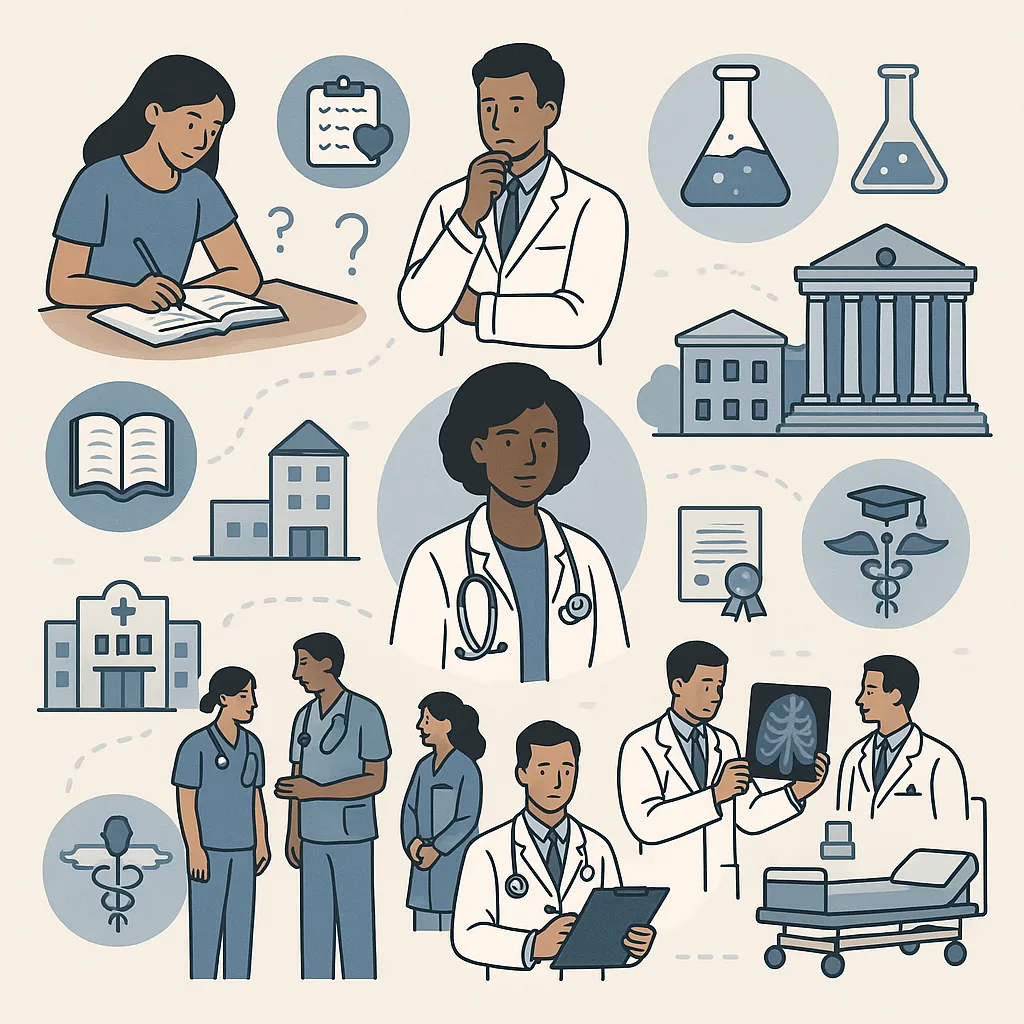
A step-by-step guide to planning your path to medical school and beyond.
Introduction
Many people dream of becoming a doctor. Doctors care for patients, diagnose illnesses, perform treatments, and help improve quality of life. It is a rewarding career, but it also requires many years of hard work, study, and responsibility.
If you are asking yourself, “What should I do if I want to be a doctor?”, this guide will walk you through the main steps: understanding the job, preparing in school, getting into medical school, completing training, and planning your life around this long journey.
1. Understand What Doctors Really Do
Before you commit to this path, it is important to know what the work is like in real life. Doctors do much more than wear white coats and stethoscopes.
- Listen to patients and ask detailed questions about symptoms and history.
- Examine patients and order tests (blood tests, X-rays, scans, etc.).
- Make diagnoses and decide on treatment plans.
- Prescribe medications or perform procedures and surgeries.
- Work long shifts, sometimes nights, weekends, and holidays.
- Write detailed notes, reports, and letters for other healthcare professionals.
- Communicate with nurses, pharmacists, therapists, and other doctors.
Doctors carry serious responsibility because their decisions affect people’s health and lives. That is why the training is long and strict.
2. Check Your Motivation and Qualities
Being a doctor is not only about good grades. It also requires certain personal qualities. Ask yourself honestly:
- Do I truly want to help people, even when they are stressed, scared, or angry?
- Can I handle blood, injuries, and serious illness?
- Am I ready to study for many years and keep learning for my whole career?
- Can I stay calm in emergencies and make decisions under pressure?
- Am I willing to work long hours and sometimes sacrifice weekends or holidays?
Nobody is perfect, and you can grow in these areas. But being honest with yourself early can save you time and stress.
3. Focus on the Right Subjects in School
Whether you are in middle school, high school, or already in college, your basic education is the foundation for medicine.
Key Subjects to Study
- Biology: The most directly related subject; you will study human anatomy, cells, genetics, and disease.
- Chemistry: Helps you understand medications, body chemistry, and lab tests.
- Physics: Useful for understanding imaging, movement, blood flow, and medical technology.
- Math: Needed for statistics, drug dosing, and research (algebra, and sometimes calculus).
- Language / English: Clear communication and writing are essential for doctors.
4. Gain Early Experience in Healthcare
Experience in real healthcare settings will help you test your interest and strengthen your future applications to medical school.
Shadowing
Shadowing means following a doctor at work to observe what they do. You usually do not touch patients or make decisions; you simply watch and learn.
- Ask family, friends, or school counselors if they know any doctors.
- Contact clinics or hospitals to ask about shadowing programs.
Volunteering
Many hospitals, clinics, and nursing homes accept volunteers. You might help with basic tasks like guiding patients, organizing supplies, or assisting staff.
- Shows your commitment to service.
- Teaches you how healthcare teams work.
Entry-Level Jobs
Depending on your country and age, you might work as a medical assistant, receptionist, lab helper, or in another support role.
- Provides stronger experience and responsibilities.
- Helps you develop communication and organizational skills.
Health-Related Clubs and Activities
Join or create clubs related to health, science, or volunteering. This can include first aid groups, science fairs, or public health campaigns.
5. Plan Your Path Through College or University
In many countries, you must complete a university degree (or at least several years of university-level study) before entering medical school. Requirements differ by country, but here are general guidelines:
Choosing a Major
You do not always have to major in “pre-med” or “biology” to become a doctor, but your coursework must cover essential science subjects.
- Common majors: biology, chemistry, biochemistry, neuroscience, or health sciences.
- Other options: engineering, psychology, or even non-science majors, as long as you also complete required science courses.
Maintaining a Strong Academic Record
Medical schools usually look for:
- High grades (especially in science subjects).
- Challenging course selection (not just the easiest classes).
- Evidence that you can handle a heavy workload.
6. Entrance Exams and Applications
Most medical schools require an entrance exam that tests your understanding of science, reading, and reasoning skills. The name of the exam depends on the country (for example, some places have a “medical college admission test” or national medical entrance exam).
To prepare:
- Review biology, chemistry, physics, and math concepts.
- Practice with official practice tests and timed exams.
- Consider study groups, prep courses, or tutors if needed.
Building a Strong Application
When applying to medical schools, you usually need:
- Academic transcripts (grades).
- Entrance exam scores.
- Letters of recommendation from teachers, supervisors, or doctors you have worked with.
- A personal statement explaining why you want to be a doctor.
- Details of your volunteer work, jobs, and extracurricular activities.
7. Life in Medical School
Once you are accepted, medical school typically lasts several years and has two main phases:
Pre-Clinical Years
- Classroom and lab-based learning.
- Subjects include anatomy, physiology, biochemistry, pathology, pharmacology, and more.
- You learn how the body works and what happens in disease.
Clinical Years
- Rotations through different hospital departments (internal medicine, surgery, pediatrics, psychiatry, etc.).
- Work directly with patients under supervision.
- Learn how to take histories, perform physical exams, and write notes.
8. Residency and Specialization
After medical school, you are usually a doctor in training, but not yet fully specialized. The next step is residency, where you focus on a specific field.
Choosing a Specialty
Examples of specialties include:
- Family medicine / general practice: Broad care for all ages.
- Internal medicine: Adult medicine and complex diseases.
- Pediatrics: Care for children.
- Obstetrics and gynecology: Pregnancy and women’s health.
- Surgery: Operative procedures, from general surgery to specialties like orthopedics.
- Psychiatry: Mental health and emotional disorders.
- Emergency medicine: Acute care in emergency departments.
- Many others: cardiology, oncology, dermatology, radiology, anesthesiology, etc.
Residency can last from a few years to over seven, depending on the specialty and country. After residency, some doctors do additional “fellowships” to sub-specialize.
9. Money, Time, and Lifestyle Considerations
Becoming a doctor is a big investment of both time and money.
- Time: Between university, medical school, and residency, the full path can take 10–15 years or more.
- Cost: Tuition, books, exams, and living expenses can be high, depending on your country.
- Loans and scholarships: Many students use a mix of financial aid, scholarships, and part-time work.
- Lifestyle: Training often includes night shifts, long hours, and stress, but later in your career, schedules may improve depending on your specialty and workplace.
10. Alternative Careers in Healthcare
As you learn more, you may discover that you love healthcare but are not sure if the doctor path is right for you. There are many other important roles, such as:
- Nurse or nurse practitioner.
- Physician assistant.
- Pharmacist.
- Physical therapist or occupational therapist.
- Medical laboratory scientist.
- Radiologic technologist or sonographer.
- Public health specialist or health educator.
These careers also help patients and may require fewer years of training.
Step-by-Step Summary
- Learn what doctors really do and reflect on your motivation.
- Focus on science and math in school and aim for strong grades.
- Gain experience by shadowing, volunteering, or working in healthcare settings.
- Choose a suitable college/university path and complete required science courses.
- Prepare for and take the required entrance exams for medical school.
- Build a strong application with experience, recommendations, and a clear personal statement.
- Complete medical school (pre-clinical and clinical years).
- Enter a residency program and choose a specialty.
- Continue learning and developing throughout your career as a doctor.
Conclusion
Wanting to be a doctor is a big and meaningful goal. The path is long, but if you plan carefully, build strong study habits, and stay connected to your reasons for helping others, it is possible.
Start where you are: study your current subjects well, look for ways to explore healthcare, and keep asking questions. Step by step, you can move closer to your dream of becoming a doctor and making a real difference in people’s lives.