
What “Chest” Really Means (Simple Anatomy)
Your chest is mainly the pectoralis major (big chest muscle) and the smaller pectoralis minor underneath. The pec major has fibers that run in different directions, which is why using different angles matters.
- Upper chest emphasis: movements that press at a slight incline (about 15–30°).
- Mid chest emphasis: flat pressing and many classic push-up variations.
- Lower chest emphasis: dips or slight decline work (not mandatory for beginners).
Key idea: You don’t “isolate” upper/mid/lower completely—but angles can shift which fibers work hardest.
The 4 Things That Actually Build Chest Muscle
1) Progressive Overload
Over time, your chest grows when you gradually increase training stress:
- More reps with the same weight
- More weight for the same reps
- More sets (within reason)
- Better form and range of motion
2) Enough Weekly Volume
Most people grow best with about 10–20 hard sets per week for the chest (counting pressing and flies). Beginners often start around 8–12 and build up.
Hard set = a set taken close to failure, usually stopping with 1–3 reps left (called RIR).
3) Good Technique (So the Chest Does the Work)
If your shoulders take over, your chest won’t grow as well. Form is not “perfect or nothing”—but it should be consistent and safe.
4) Recovery + Nutrition
Your chest doesn’t grow during the workout. It grows while you recover—especially when you eat enough protein and sleep well.
Best Chest-Building Exercises (With a Simple Purpose)
Use a combination of pressing (heavy builders) and fly/bringing arms together movements (stretch and squeeze).
Top Pressing Movements
- Barbell Bench Press (Flat): best for overall strength and mass.
- Dumbbell Bench Press (Flat): great range of motion and chest activation.
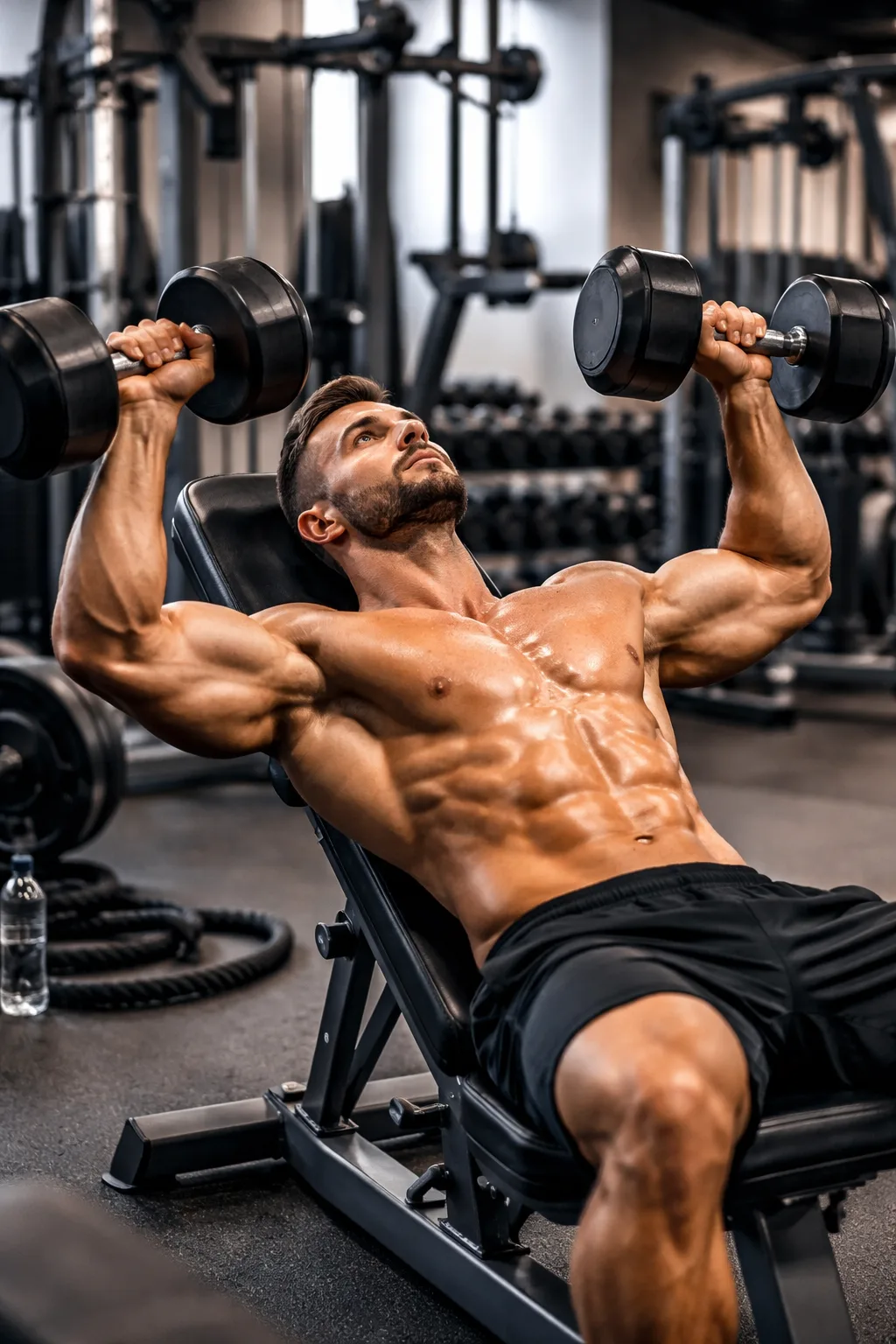
- Incline Dumbbell Press (15–30°): excellent for upper chest emphasis.
- Push-ups (weighted or hard variations): extremely effective, easy to do anywhere.
- Dips (slight forward lean): strong chest/triceps builder (only if shoulders feel good).
Top “Fly / Squeeze” Movements
- Dumbbell Fly (flat or slight incline): chest stretch and control.
- Cable Fly (high-to-low, mid, or low-to-high): constant tension and great pump.
- Pec Deck Machine: stable and easy to learn, great for hypertrophy.
Simple rule: Start most workouts with a press (heavy + controlled), then finish with a fly/cable/machine movement to fully fatigue the chest.
Form Tips That Make Chest Training Work Better
Bench Press (Barbell or Dumbbells): Quick Checklist
- Shoulder blades: pull them “down and back” and keep them stable on the bench.
- Chest up: think “proud chest,” not extreme arching.
- Elbows: avoid flaring straight out; aim around 30–60° from your body.
- Lowering: control the weight; don’t bounce.
- Range of motion: go as deep as comfortable without shoulder pain.
- Feel the chest: drive the weight up while keeping shoulders stable.
Push-ups: Make Them Chest-Focused
- Hands slightly wider than shoulder width (adjust for comfort).
- Keep a strong plank (glutes tight, ribs down).
- Lower until your chest is close to the floor.
- To progress: elevate feet, slow tempo, pause at bottom, add weight (backpack/plate/vest).
Fly Movements: Protect Your Shoulders
- Use a slight bend in your elbows (don’t lock them straight).
- Move slowly—especially in the stretch.
- Stop the stretch before your shoulders feel unstable or painful.
- Think: “bring biceps toward each other,” not “throw hands together.”
How Often to Train Chest (Frequency)
Most people do best training chest 2 times per week. This gives you enough practice and volume without overloading your joints.
- 1x/week: can work, but progress may be slower.
- 2x/week: best balance for most lifters.
- 3x/week: can work if volume per session is lower and recovery is good.
Chest Workouts You Can Copy (Gym + Home)
Gym Workout A (Strength + Size)
- Barbell Bench Press — 4 sets × 5–8 reps (stop with 1–2 reps left)
- Incline Dumbbell Press — 3 sets × 8–12 reps
- Cable Fly (mid or low-to-high) — 3 sets × 12–15 reps
- Push-ups (slow) — 2 sets to near-failure
Rest: 2–3 min on bench, 90–120 sec on other moves.
Gym Workout B (Hypertrophy Focus)
- Dumbbell Bench Press — 4 sets × 8–12 reps
- Machine Chest Press — 3 sets × 10–15 reps
- Pec Deck or Cable Fly — 3 sets × 12–20 reps
- Dips (optional) — 2 sets × 6–12 reps (only if pain-free)
Tip: keep the last 2 sets very close to failure (0–2 reps left).
Home Workout (No Equipment)
- Push-ups — 4 sets to near-failure
- Feet-Elevated Push-ups — 3 sets to near-failure
- Slow Tempo Push-ups (3 seconds down) — 2–3 sets
- Chair/Bench Dips (optional) — 2 sets (watch shoulders)
Progression: add a backpack with books, increase reps, or make the exercise harder (pause, slower tempo).
Home Workout (With Dumbbells/Bands)
- Dumbbell Floor Press — 4 sets × 8–12 reps
- Incline Push-ups (hands on a sturdy table/couch) — 3 sets × 10–20
- Dumbbell Fly (light) — 3 sets × 12–15
- Band/Cable-Style Fly — 2–3 sets × 15–25
Example Weekly Plan (Chest 2x/Week)
| Day | Focus | What You Do |
|---|---|---|
| Mon | Upper Body (Chest heavy) | Workout A (or bench + incline + fly) |
| Tue | Lower Body | Legs + core |
| Wed | Rest / Light cardio | Walk, stretch, mobility |
| Thu | Upper Body (Chest volume) | Workout B (or dumbbell press + machine + fly) |
| Fri | Lower Body | Legs + core |
| Sat | Optional | Arms/shoulders or easy cardio |
| Sun | Rest | Recovery + meal prep |
Adjust it: If you only train 3 days/week, do chest on Day 1 and Day 3 and keep total sets moderate.
How to Progress (So You Don’t Get Stuck)
Use Double Progression
Pick a rep range (example: 8–12). Keep the same weight until you can hit the top reps on all sets, then increase weight.
- Week 1: 8, 8, 7
- Week 2: 9, 8, 8
- Week 3: 10, 9, 8
- Week 4: 12, 11, 10 → add weight next time
Track These 3 Things
- Loads: weight used
- Reps: per set
- Effort: how close to failure (1–3 reps left most sets)
If these improve over weeks, your chest will almost always grow—assuming nutrition and sleep are decent.
Nutrition for Chest Growth (Simple, Realistic)
- Calories: For muscle gain, aim for a small surplus (about +200 to +300 calories/day). If you don’t want to gain weight, you can still build muscle slowly at maintenance.
- Protein: Aim for roughly 1.6–2.2 g per kg of bodyweight per day (about 0.7–1.0 g per lb).
- Carbs: Help you train harder (rice, oats, potatoes, fruit).
- Hydration: Being dehydrated reduces performance and pumps.
Easy protein ideas: eggs, tuna/sardines, chicken/turkey, Greek yogurt, milk, beans, tofu, whey protein.
Recovery: The “Hidden” Growth Factor
- Sleep: target 7–9 hours if possible.
- Rest days: chest usually needs 48–72 hours before training hard again.
- Joint health: if shoulders hurt, reduce range slightly, use dumbbells/machines, and improve technique.
Common Mistakes (And How to Fix Them)
- Too much weight, bad control: lower the load, slow the reps, get a full stretch.
- Only flat bench forever: add incline pressing + a fly movement.
- Training to failure every set: keep most sets 1–3 reps from failure; save true failure for the last set or isolation work.
- Not enough volume: if progress stalls, add 2–4 sets/week.
- Not recovering: if soreness and fatigue never improve, reduce sets and prioritize sleep.
Should You Feel Your Chest Working?
Yes—but don’t chase sensation only. The best sign is progress: stronger pressing and more reps over time.
- If you mostly feel front shoulders: tuck elbows a bit, stabilize shoulder blades, reduce weight.
- If you mostly feel triceps: use a slightly wider grip/hand position and add fly movements.
- If you feel pain (sharp, pinching): stop and modify the exercise.
Quick Starter Plan (Beginner-Friendly)
If you’re new, start with this for 4–6 weeks:
- Twice per week: 3–4 sets of a press + 2–3 sets of a fly/push-up variation.
- Reps: 6–12 on presses, 10–20 on fly/cables/push-ups.
- Effort: stop with 1–3 reps left most sets.
After 4–6 weeks, if recovery is good, add 1–2 sets per session.