
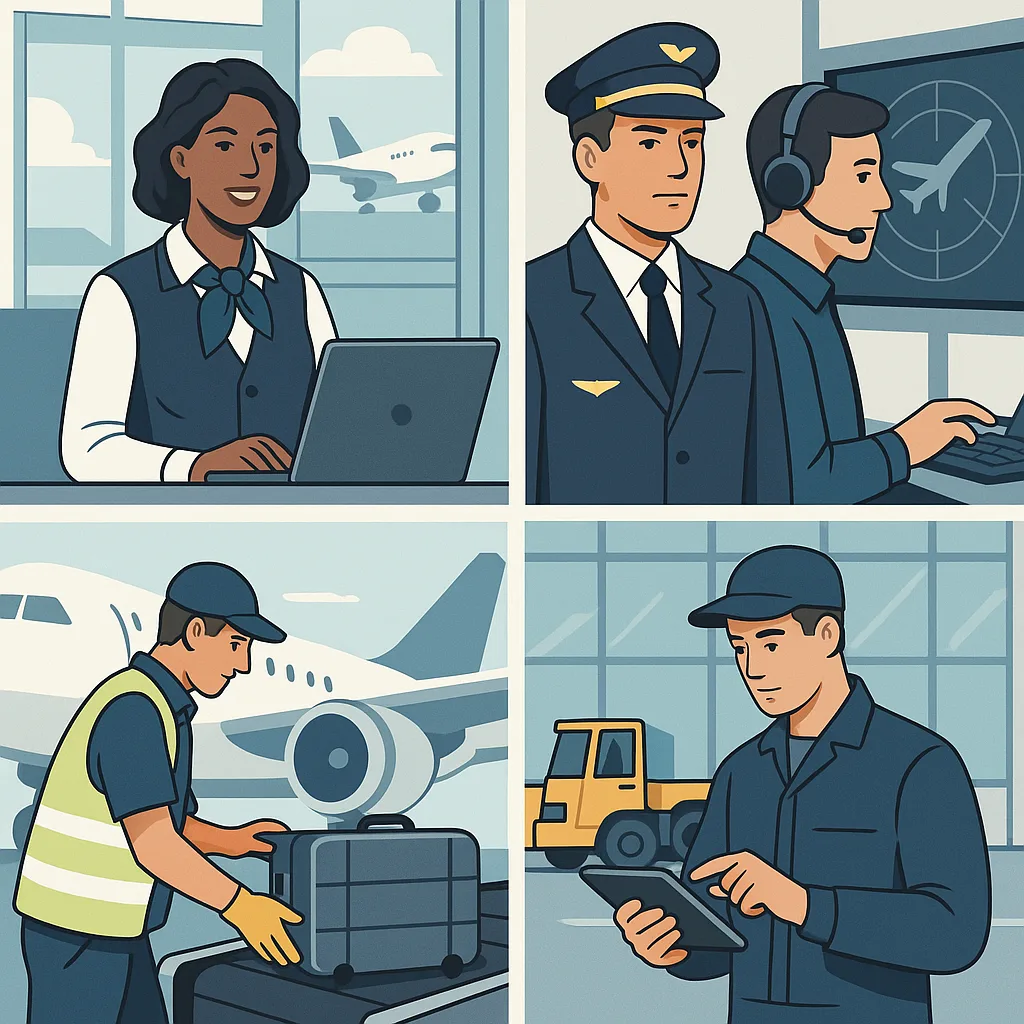
Discover the many careers that keep airports running safely and on time.
Introduction
Airports are like small cities. Every day, thousands of passengers, workers, and tons of cargo move through them. Behind the scenes, many different jobs work together to make sure flights are safe, luggage is handled correctly, and travelers get where they need to go.
If you enjoy a fast-paced environment, working with people from around the world, and being close to airplanes, an airport job might be a great fit. This article explains the main categories of airport jobs, what each role does, what skills and qualifications they require, and how you can start a career at an airport.
How Airports Are Organized
To understand airport jobs, it helps to know who runs the airport:
- Airport authority: The organization (often a government or private company) that manages the airport facilities.
- Airlines: Companies that operate the aircraft and employ pilots, flight attendants, and many ground staff.
- Security agencies: National or private security organizations that handle passenger and baggage screening.
- Service providers: Companies that handle baggage, cleaning, catering, fueling, maintenance, and retail.
Many people at an airport wear different uniforms and badges because they may work for different companies, even though they share the same workplace.
Major Categories of Airport Jobs
Airport jobs can be grouped into several broad categories:
- Customer-facing roles (helping passengers directly).
- Ground operations and baggage handling.
- Security and safety.
- Aircraft operations and air traffic control.
- Technical and maintenance roles.
- Management, administration, and support services.
- Retail, food, and hospitality.
Below is a closer look at specific roles in each category.
Customer-Facing Airport Jobs
These roles focus on helping passengers with tickets, boarding, directions, and special needs. Strong communication and people skills are essential.
Check-in Agent / Ticketing Agent
- Helps passengers check in for flights and issue boarding passes.
- Checks travel documents and luggage weight/size.
- Explains baggage rules, seat changes, and flight information.
Skills: Friendly communication, basic computer skills, ability to stay calm under pressure.
Gate Agent
- Makes announcements about boarding, delays, and gate changes.
- Assists passengers with boarding, seat issues, and last-minute changes.
- Coordinates with flight crew and ground staff to ensure on-time departure.
Skills: Clear speaking, multitasking, problem-solving with passengers.
Passenger Service Agent
- Provides general assistance in the terminal.
- Helps passengers with disabilities, unaccompanied minors, or special requests.
- Offers directions, information, and support during disruptions.
Skills: Patience, empathy, cultural sensitivity.
Flight Attendant (Cabin Crew)
- Works onboard the aircraft, ensuring passenger safety and comfort.
- Conducts safety demonstrations and checks, serves food and drinks.
- Handles in-flight emergencies and assists passengers with special needs.
Skills: Strong customer service, safety awareness, ability to stay calm in emergencies.
Ground Operations and Baggage Handling
Ground operations staff work on the ramp and in baggage areas. They make sure luggage, cargo, and aircraft are handled safely and correctly.
Baggage Handler / Ramp Agent
- Loads and unloads baggage and cargo from aircraft.
- Operates belt loaders, baggage carts, and other ground equipment.
- Ensures bags go to the correct flights and conveyors.
Skills: Physical fitness, ability to work in all weather, attention to labels and destinations.
Ground Operations Agent
- Coordinates aircraft parking, pushback, and turnaround processes.
- Communicates with pilots and dispatch to manage on-time performance.
- Checks that catering, cleaning, fuel, and baggage are completed on time.
Skills: Coordination, time management, radio communication.
Loadmaster / Weight & Balance Specialist
- Calculates how cargo and baggage should be distributed in the aircraft.
- Prepares weight and balance documents for pilots.
- Ensures safe loading limits and center-of-gravity requirements.
Skills: Math, accuracy, knowledge of aircraft limitations.
Cargo Agent
- Handles freight shipments and documentation.
- Coordinates with trucking companies, customs, and warehouse staff.
- Ensures cargo is properly labeled, packaged, and loaded.
Skills: Organization, data entry, understanding of shipping rules.
Security and Safety Jobs
Airport security roles protect passengers, staff, and aircraft from threats. They require strict procedures and attention to detail.
Security Screener
- Operates X-ray machines and metal detectors for passengers and baggage.
- Performs pat-downs and bag inspections when necessary.
- Monitors for prohibited items and unusual behavior.
Skills: Concentration, following procedures, professionalism.
Airport Police / Law Enforcement
- Maintains law and order on airport property.
- Responds to incidents, accidents, and emergencies.
- Works with national security agencies when needed.
Skills: Law enforcement training, conflict resolution, physical fitness.
Firefighter / Rescue Services (ARFF)
- Specializes in aviation fire and rescue operations.
- Responds to aircraft incidents, fuel spills, and medical emergencies.
- Conducts regular safety drills and inspections.
Skills: Firefighting certification, teamwork, rapid decision-making.
Safety & Compliance Officer
- Inspects operations to ensure they meet safety regulations.
- Investigates incidents and recommends improvements.
- Trains staff on safety procedures and emergency plans.
Skills: Analytical thinking, knowledge of regulations, report writing.
Aircraft Operations and Air Traffic Control
These roles are directly connected to aircraft movement and flight safety. They often require specialized training and strict medical standards.
Pilot
- Operates the aircraft safely from takeoff to landing.
- Plans flight routes, checks weather, and ensures fuel and weight limits.
- Communicates with air traffic control and cabin crew.
Requirements: Flight licenses, medical certificates, and type ratings depending on aircraft size.
Air Traffic Controller (ATC)
- Manages the movement of aircraft in the air and on the ground.
- Provides pilots with clearances, headings, altitudes, and runway instructions.
- Prevents collisions and maintains safe separation between aircraft.
Skills: Fast decision-making, strong focus, excellent communication.
Flight Dispatcher / Operations Controller
- Plans flights together with pilots (routes, fuel, alternate airports).
- Tracks flights and updates crews on weather or operational changes.
- Helps make decisions during irregular operations (delays, diversions).
Skills: Analytical skills, knowledge of meteorology, regulations, and aircraft performance.
Apron / Ramp Controller
- Directs aircraft as they taxi in non-controlled apron areas.
- Coordinates parking positions, towing, and pushback.
- Uses radios to communicate with pilots and ground staff.
Skills: Spatial awareness, coordination, understanding of airport layouts.
Technical and Maintenance Jobs
Technical staff keep aircraft and airport equipment operating safely and efficiently.
Aircraft Maintenance Technician / Aircraft Engineer
- Inspects, repairs, and maintains aircraft systems (engines, avionics, structures).
- Performs scheduled checks and unscheduled repairs.
- Signs off aircraft as airworthy according to regulations.
Requirements: Aviation maintenance license or certification, technical training.
Avionics Technician
- Specializes in aircraft electronic systems: navigation, communication, displays.
- Uses testing equipment to troubleshoot faults.
- Updates software and firmware when needed.
Skills: Electronics knowledge, soldering, reading wiring diagrams.
Airport Systems Technician
- Maintains airport equipment like baggage systems, jet bridges, and lighting.
- Repairs mechanical, electrical, or IT components.
- Responds to breakdowns to minimize delays.
Skills: Mechanical/electrical skills, troubleshooting, safety awareness.
IT & Communications Specialist
- Supports airport networks, servers, and software systems.
- Maintains communication systems for staff and operations centers.
- Helps with cyber security and system upgrades.
Skills: IT knowledge, networking, security, ability to work on critical systems.
Management, Administration, and Support Jobs
In addition to frontline roles, airports and airlines need staff in planning, finance, human resources, and more.
Airport Manager / Operations Manager
- Oversees day-to-day airport operations.
- Coordinates between airlines, security, ground handling, and government agencies.
- Manages budgets, staff, and long-term planning.
Human Resources (HR) & Training
- Recruits and hires staff across departments.
- Organizes training, scheduling, and performance reviews.
- Ensures compliance with labor laws and company policies.
Finance and Accounting
- Manages airport or airline budgets, billing, and financial reports.
- Handles payments, vendor contracts, and cost control.
Planning and Development
- Designs future terminal expansions, runways, and infrastructure projects.
- Analyzes passenger growth, capacity, and environmental impact.
Retail, Food, and Hospitality Jobs
Many jobs at airports are similar to jobs in malls or hotels, but in a unique travel environment.
- Duty-free shop staff and retail sales associates.
- Restaurant cooks, servers, and baristas.
- Hotel staff for airport hotels and lounges.
- VIP lounge attendants and concierge services.
These roles focus on customer service, speed, and handling international travelers.
Common Requirements for Airport Jobs
Requirements vary by country and employer, but many airport jobs share some basic conditions:
- Background checks: Because airports are sensitive areas, many jobs require security clearances.
- Flexible hours: Airports operate early mornings, late nights, weekends, and holidays.
- Physical fitness: Some roles involve lifting luggage, walking long distances, or standing for hours.
- Language skills: English is common, plus local language(s). Extra languages are a big advantage.
- Teamwork: Almost every role involves coordination with other departments.
Education and Training Paths
Each job type has its own training path:
- Entry-level customer service or baggage roles: Often require a high school diploma and on-the-job training.
- Technical roles: May require vocational training, certifications, or associate degrees in mechanics, electronics, or IT.
- Pilots and air traffic controllers: Need specialized training programs, licenses, and medical exams.
- Management and planning: Often require university degrees in business, aviation management, engineering, or related fields.
Many airports and airlines offer their own training centers or partner with aviation schools and colleges.
How to Start a Career at the Airport
If you’re interested in working at an airport, here are practical steps:
- Research local airports and airlines. Check their websites for “Careers” or “Jobs” sections and see what roles are currently hiring.
- Choose a starting point. Decide whether you prefer customer service, physical work on the ramp, technical roles, or office work.
- Prepare your resume. Highlight skills like communication, teamwork, language abilities, and any experience with customers, logistics, or technology.
- Apply widely. Consider ground handling companies, security firms, airlines, and airport authorities—not just one employer.
- Get used to shift work. Be ready to mention in interviews that you can work early, late, weekends, and holidays.
- Look for growth opportunities. Once hired, ask about internal training, cross-training in other departments, and promotion paths.
Advantages and Challenges of Airport Jobs
Advantages
- Exciting, dynamic environment with constant activity.
- Interaction with people from many cultures and countries.
- Travel benefits in some roles (discounted or free flights for staff and family).
- Variety of career paths within the same industry.
Challenges
- Irregular working hours and changing shifts.
- Stress during peak travel times, delays, and disruptions.
- Working outdoors in all weather (for ramp and ground roles).
- Strict security rules and procedures that must be followed at all times.
Conclusion
Airport jobs cover a wide range of skills and interests—from helping passengers and loading baggage to flying planes and maintaining complex systems. Whether you enjoy customer service, technical work, or management, there is likely a role at the airport that fits your strengths.
By understanding the different job types, their requirements, and how they work together, you can choose a path that matches your goals. With dedication, flexibility, and a willingness to learn, an airport job can grow into a long-term and exciting career in the world of aviation.